A federal agency has authorized the killing of some California sea lions that prey on migrating salmon and steelhead at the base of Bonneville Dam on the Columbia River.
By some estimates, the sea lions at the base of the dam take up to 4 percent of the spring chinook run headed upriver to spawn.
Opponents of the kill have said sea lions are a highly visible and politically convenient target when the real problem lies elsewhere, such as the hydroelectric dams. The Humane Society of the United States and other groups also cite other hurdles facing fish, such as the deterioration of spawning grounds, bird predation of salmon smolts headed to the ocean and agricultural runoff and other pollution.
Nonlethal attempts to keep the sea lions away from the dam, such as rubber buckshot, loud noises and pyrotechnics, generally were deemed failures. Some sea lions trapped and taken to the mouth of the Columbia River 140 miles downriver returned to the dam in two or three days.
The authorization is valid until June 30, 2012, and can be extended for five years; it can be also revoked by the National Marine Fisheries Service with 72 hours notice.
Source: Los Angeles Times
via: L.A. Unleashed
Thursday, April 17, 2008
Humanity messing with nature
Prickly pets are the latest fad
Busy British pet lovers have been buying hedgehogs, whose nocturnal habits make them appealing to the modern worker because they wake in the evening when their owners arrive home after a day in the office.
Although Britain has its own wild breed of hedgehogs, the latest pet craze focuses on African pygmy hedgehogs -- a cross between Algerian and white-bellied hedgehogs.
"They are unbelievably pretty little creatures, the way they bumble along, the way they poke their noses into everything," British hedgehog breeder Bonnie Martin told Reuters.
Initial costs for the animal and accompanying equipment can run to 300 pounds ($591).
"spike200503b" uploaded by kschinchillas
Source: Reuters
Wednesday, April 16, 2008
Saving lives with venom
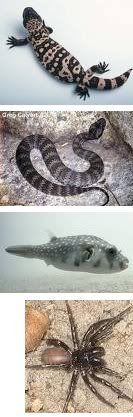
There are thousands of venomous animal species on Earth. Just a few of the most lethal are the Gila monster, the death adder, the fugu puffer fish and the Sydney funnel web spider.
Medical researchers are finding a positive side to these dangerous creatures: the complex and highly sophisticated poisons produced by these creatures have components that might save lives rather than kill.
The PBS show, Nature, Victims of Venom, illustrates how some of the animals we fear most may one day soon be helping us solve or alleviate a wide range of life-threatening medical problems.
Venomous animals use their toxins to capture prey or defend themselves. They inflict their poisons by biting, stinging, and, in the case of some marine animals, by emitting venom into the water so it can be absorbed through the skin. The venom itself typically comprises many different substances that have various effects on their victims.
The film introduces us to carefully trained researchers around the world who are risking harm - even death - to themselves by "milking" the venom of live animals so that the various components of these poisons can be studied in great detail and better understood, perhaps preparing the way for clinical trials against a variety of diseases and medical conditions. It's not only a dangerous job but a laborious one, since only tiny amounts of venom can be extracted at a time.
Heart disease, stroke, various cancers, and the management of chronic and severe pain are other potential targets of the chemicals that comprise venom.
Komodo Dragon's Deadly Bite
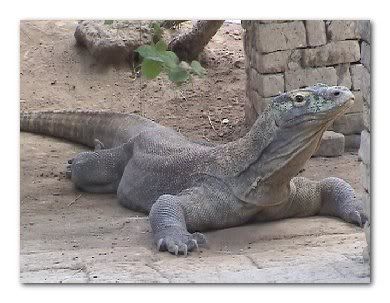
Komodo dragons may have a wimpy bite for their size, but somehow the giant lizards manage to take down prey as large as water buffalos.
A new study reveals that a few dozen razor-sharp teeth combined with beefy neck muscles make up for the reptile's dainty chomp.
The Komodo displays a unique hold-and-pull feeding technique. The lizard nabs prey with 60 perilous teeth, although its bite is weak. To make up for the lack of biting power, strong throat muscles drag the meal through the razor-sharp jowls and into the stomach.
Once a Komodo dragon maims its prey, which can weigh nearly as much as the lizard, it is swallowed whole and later regurgitated in a foul-smelling pellet of hair, bone and other indigestible remains. The lizards are also known for their infectious bites and parthenogenesis, or the ability to reproduce without mating.
Source: Yahoo News
Tuesday, April 15, 2008
Feline CSI
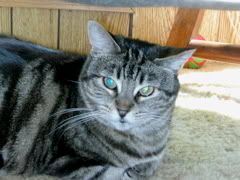
This is Mary.
Mary has a problem: the hair around her rectum is missing. That area is very pink and a little bloody, but not swollen.
What's wrong with Mary?
Read Cat Care, Breeds and Resources Blog for the answer.
Not welcome in Chicago
A cougar ran loose in Chicago on Monday for the first time since the city's founding in the 19th Century. But by day's end, the animal lay dead in a back alley on the North Side, shot by police who said they feared it was turning to attack.
No one knew where the 5-foot long, 150-pound cat came from, though on Saturday Wilmette police had received four reports of a cougar roaming that suburb, roughly 15 miles from the site of Monday's shooting.
Source: Chicago Tribune
A close second?
The Daily Mail has printed photos of Orazi, the ginger tom cat who weighs in at a whopping 35.2 lb. Orazi lives in Eupilio, Italy.
I think Monty, who lives with my friends Christina and Luke, is almost as large as Orazi. I'm not sure how much Monte weighs - they probably can't lift him up to weigh him.
What do you think? Close?
Cindy: the queen of doggy tricks
Meet Cindy, the Cavalier King Charles who’s the queen of doggy-balancing.
Cindy the Cavalier King Charles is able to carry out a dazzling display of tricks taught to her by Wolverhampton owner Ron Bucknall.
Watch the video of Cindy performing. via: Ursi's Blog
Source: expressandstar.com
Monday, April 14, 2008
African Wild Dogs Debut at the LA Zoo
African wild dogs, native to the vast and beautiful sub-Saharan Africa, are making the Los Angeles Zoo their home for the first time in nearly 40 years.
The African wild dog is an endangered species. It is estimated that the total population is fewer than 5,000 dogs.
L.A. Zoo's pair of dogs, courtesy of New York’s Bronx Zoo, is two of just under 150 African wild dogs in zoos across the United States.
These dogs are part of an aggressive plan to try and preserve the species. A number of zoos, including the L.A. Zoo, are looking to help wild dog conservation efforts by participating in the Species Survival Plan Program (SSP) established in 1981 by the Association of Zoos and Aquariums (AZA). The program tracks a species’ genetic ancestry so that appropriate mates can be found for the animal in question. For example, the L.A. Zoo has two wild dogs, but since they are brother and sister, it would be inappropriate to breed them. In the future, if the Zoo were to receive a breeding recommendation, the Zoo would work with the AZA to locate suitable mates for the dogs. A zoo that has a compatible mate would then exchange that animal with the L.A. Zoo so that the quality breeding programs could continue.
Sunday, April 13, 2008
Saturday, April 12, 2008
Rat wars in India
India's armed forces, which have been battling insurgents in the northeast for over six decades, are now engaged with another enemy - rats. The rat population in the northeastern states of Mizoram and Manipur - the two states bordering Myanmar - has witnessed a massive growth. With rats destroying crops and devouring grain, the threat of famine looms over the region. Soldiers deployed in the area to fight insurgents are being called in to help the civilian administration tackle the impending crisis. The explosion in the rat population has been triggered by the flowering of a certain species of bamboo (Melocanna baccifera) that grows mainly in Mizoram but in other neighboring states as well. Thirty percent of Mizoram is covered by wild bamboo forests. The flowering of this bamboo results in millions of seeds being dropped. Rats devour these seeds. The high protein content of the seeds is believed to either dramatically increase fertility rates among the rats or provide them with the nutrition to enhance survival rates of the entire litter. Litters of over a dozen rats survive and within three months are ready to reproduce themselves. This has resulted in a major rat population explosion. Some experts say that the rat population in Mizoram is perhaps ten times that of humans in the state. Source: Asia Times Online
Rat catching in UK
With rat infestations estimated to be up by nearly 40 per cent in the past six years, a group of rugby players who started ratting on a Sunday morning to exercise their dogs now have more invitations to farms than they can cope with.
The Malton & Norton Rugby Ratcatchers, who set off most Sunday mornings from the Spotted Cow pub in Malton, North Yorkshire, enjoy bacon sandwiches and mugs of tea before getting out their terriers, the wisest among them tucking trousers into socks to stop any rodent making a run for freedom up their legs.
David Harrison, who farms 300 acres on the Yorkshire Wolds, was constantly out poisoning rats. He says catching the rats with terriers is safer for his livestock - there are no longer any worries about the pigs picking up any of the poison - and for wildlife.
At Harrison's farm, the terriers set a new record, killing 103 rats in two hours.
Source: Telegraph
Rats!
Michele Diller, 64, of Rochester, WA, bought rats as food for her pet snakes but eventually came to think of them as ''friends'' and allowed them to breed and overrun her house.
The rats have gnawed through wiring, walls, cupboards and drawers, and have begun turning up in neighbors' yards.
When Animal Control officials entered the house, they saw that rat feces covered table tops, floors, chairs - virtually every flat surface in the house. In addition, the carpets were saturated with rat urine, and the air inside the home was heavy with odors and moisture. There was no electricity in most rooms of the house because the rats had chewed through the wiring. In addition, the sewage had backed up and there was no running water or heat in the home.
The sound of rats chewing in the walls and floors was a "constant undertone."
Souce: KOMO-TV
Friday, April 11, 2008
Fish sounds
I never knew fish made sounds. It's hard to believe that they do, but when you think about it, why not? Most other animals make noises, so why not fish?
In "Run Noisy, Run Deep," the New York Times samples of some of the sounds made by five species of fish.
My favorite is the clownfish which are prolific "singers" that produce a wide variety of sounds, described as "chirps" and "pops" in both reproductive and agonistic behavioral contexts. Clownfish sounds were recorded as early as 1930, but it was just recently that scientists discovered the unusual ligament that allows this fish to pull its jaws together quickly to produce the sounds.
The accompanying article, "What’s Making That Awful Racket? Surprisingly, It May Be Fish," tells an interesting story about Cape Coral, FL, where residents were pushing the City Council to pay an engineering firm more than $47,000 to eliminate the nightly noise reverberating through their homes.
James Locascio, a doctoral student in marine science at the University of South Florida, rescued the city from financial folly.
He explained that at 100 to 500 hertz, black drum mating calls travel at a low enough frequency and long enough wavelength to carry through sea walls, into the ground and through the construction of waterfront homes like the throbbing beat in a passing car.
How cool.
Lawsuit blames sick hamster for 3 deaths
A woman whose husband died after receiving a liver transplant claims a diseased hamster purchased at a pet store is to blame. Nancy Magee, 51, of Whitman, Mass., is suing PetSmart for negligence. Thomas J. Magee was one of three people who died after receiving organs donated by a woman who had contracted lymphocytic choriomeningitis (LCMV) from a hamster she bought at a PetSmart in Warwick, R.I., according to a law suit Magee has filed in federal court. The organ donor later died of an unrelated stroke and the transplants were done by hospitals which had no knowledge of her disease. According to the Centers for Disease Control Web site, lymphocytic choriomeningitis is a rodent-borne viral infectious disease with symptoms similar to meningitis. Thomas Magee’s liver transplant was performed at Massachusetts General Hospital in April 2005. Five days later, the suit says, he “was exhibiting high blood pressure and a fever.” Weeks later he died and according to the suit, the virus was the cause of death. “The immediate cause of” Thomas Magee’s death was “determined to have been the dissemination of LCMV in the liver he received.” Source: the Boston Channel
Thursday, April 10, 2008
Book review: Businesses for Pet Lovers
101 Best Businesses for Pet Lovers
What You Need to Know about Starting and Succeeding in a Pet Business of Your Own is a great reference for anyone who loves pets and is thinking about turning that qualification into a means for making money.
The money spent on pets has more than doubled since 1994, creating a multi-billion-dollar industry that is even more lucrative than the human toy industry. 101 Best Businesses for Pet Lovers lists a wide variety of moneymaking opportunities from something as simple as dog walking, to careers which require education and training such as pet grooming and pet masseuse.
Authors Joseph Nigro and Nicholas Nigro are well qualified to write about this subject. Joseph began his entrepreneurial career with pet shops which he was eventually able to sell to the Petco Company in 1996 for $19.1 million.
101 Best Businesses for Pet Lovers interested me on a personal level because I am one of those people who turned my love of animals into a business - Internet Pet Supplies - Internet Pet Supplies has been selling pet treats and pet supplies on the Internet since 1998. i-pets.com does not have a physical store, we sell only on the internet. I started very cautiously, selling only a few items, mainly USA rawhide treats, and have increased the products carried because of customer feedback.
I would recommend this book, it is well researched, well written, and offers some very imaginative ways of making money.