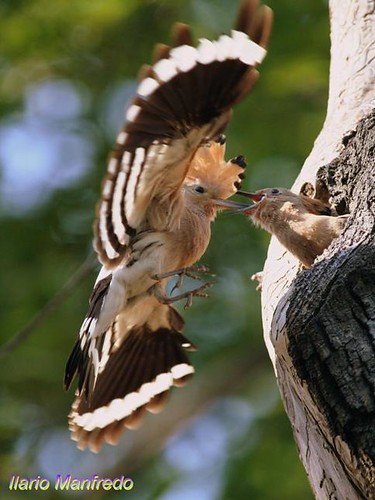
 It may not be kosher, but the Hoopoe was chosen Thursday as Israel's national bird.
The Hoopoe, or "Duchifat" in Hebrew, is listed in the Old Testament as unclean and forbidden food for Jews.
President Shimon Peres declared the pink, black and white-crested bird the winner of a competition timed to coincide with Israel's 60th anniversary. It beat out rivals such as the Yellow-vented Bulbul and the Palestine Sunbird.
Photo: ilarius
Source: Reuters
It may not be kosher, but the Hoopoe was chosen Thursday as Israel's national bird.
The Hoopoe, or "Duchifat" in Hebrew, is listed in the Old Testament as unclean and forbidden food for Jews.
President Shimon Peres declared the pink, black and white-crested bird the winner of a competition timed to coincide with Israel's 60th anniversary. It beat out rivals such as the Yellow-vented Bulbul and the Palestine Sunbird.
Photo: ilarius
Source: Reuters
Friday, May 30, 2008
Israel has a national bird



Thursday, May 29, 2008
Special and unusual felines
We hear about famous and heroic dogs all the time; cats, not so often. I think it's because cats are not braggarts like dogs. Sure, there are many, many exemplary cats out there - they just shun publicity.
Here are the stories of some very unusual kitties:
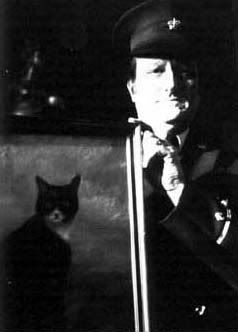 Oscar a.k.a. "Unsinkable Sam"
The black and white patched cat had been owned by an unknown crewman of the German battleship Bismarck. He was on board the ship on 18 May 1941 when it set sail on Operation Rheinübung, Bismarck's first and only mission.
Bismarck was sunk after a fierce sea-battle on 27 May, from which only 115 from its crew of over 2,200 survived. Hours later, the cat was found floating on a board and picked from the water, the only survivor to be rescued by the homeward-bound British destroyer HMS Cossack. Unaware of what his name had been on Bismarck, the crew of Cossack named their new mascot "Oscar".
About five months later, Cossack was hit and destroyed by a German submarine, and Oscar was again among the survivors.
The cat was then brought aboard the famous aircraft carrier HMS Ark Royal, but only three weeks later, this ship, too, was torpedoed by a submarine.
This luckily ended the cat's naval career. He was transferred first to the offices of the Governor in Gibraltar, and then sent back to the UK, where he saw out the remainder of the war living in a seamen's home in Belfast.
Sam died in 1955.
Oscar a.k.a. "Unsinkable Sam"
The black and white patched cat had been owned by an unknown crewman of the German battleship Bismarck. He was on board the ship on 18 May 1941 when it set sail on Operation Rheinübung, Bismarck's first and only mission.
Bismarck was sunk after a fierce sea-battle on 27 May, from which only 115 from its crew of over 2,200 survived. Hours later, the cat was found floating on a board and picked from the water, the only survivor to be rescued by the homeward-bound British destroyer HMS Cossack. Unaware of what his name had been on Bismarck, the crew of Cossack named their new mascot "Oscar".
About five months later, Cossack was hit and destroyed by a German submarine, and Oscar was again among the survivors.
The cat was then brought aboard the famous aircraft carrier HMS Ark Royal, but only three weeks later, this ship, too, was torpedoed by a submarine.
This luckily ended the cat's naval career. He was transferred first to the offices of the Governor in Gibraltar, and then sent back to the UK, where he saw out the remainder of the war living in a seamen's home in Belfast.
Sam died in 1955.
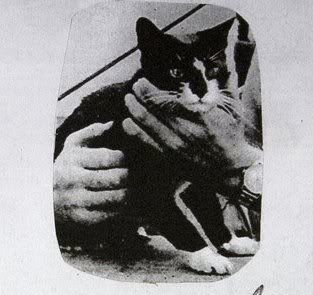 Simon
Simon served on the Royal Navy sloop HMS Amethyst 1948 through November 1949.
Simon received the animal equivalent of the Victoria Cross for gallantry after he protected food stores on the HMS Amethyst from an infestation of rats, despite being badly injured in shelling by Chinese Communist forces during the country’s civil war.
He was later posthumously awarded the Dickin Medal for bravery, instituted in 1943 by Maria Dickin CBE, the founder of veterinary charity the PDSA, and was given the rank of "Able Seaman". Simon is the only cat among 62 animals to be awarded the Dickin Medal.
Simon
Simon served on the Royal Navy sloop HMS Amethyst 1948 through November 1949.
Simon received the animal equivalent of the Victoria Cross for gallantry after he protected food stores on the HMS Amethyst from an infestation of rats, despite being badly injured in shelling by Chinese Communist forces during the country’s civil war.
He was later posthumously awarded the Dickin Medal for bravery, instituted in 1943 by Maria Dickin CBE, the founder of veterinary charity the PDSA, and was given the rank of "Able Seaman". Simon is the only cat among 62 animals to be awarded the Dickin Medal.
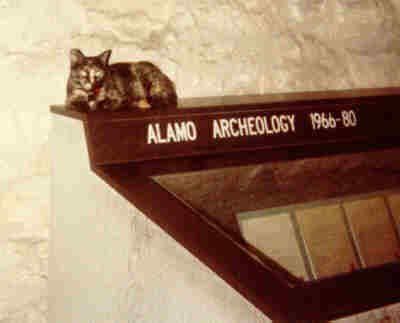 Ms. Ruby LeGato
Ruby patrolled the Alamo in Texas from 1981 through 1985. Ruby was awarded a certificate of completion of the Basic Security Officer Training course from San Antonio College.
In 1988 Ruby was immortalized in Rita Kerr's book, "The Alamo Cat
Ms. Ruby LeGato
Ruby patrolled the Alamo in Texas from 1981 through 1985. Ruby was awarded a certificate of completion of the Basic Security Officer Training course from San Antonio College.
In 1988 Ruby was immortalized in Rita Kerr's book, "The Alamo Cat
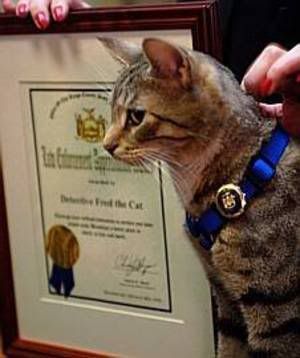 Fred
He came from the streets of Brooklyn, a cool customer on four legs, the perfect bait for a sting on a fake veterinarian. In February 2006, Fred was enlisted by the Brooklyn District Attorney’s office as an undercover secret agent, posing as a would-be patient to help the NYPD apprehend Steven Vassall, a Brooklyn man suspected of acting as a veterinarian without proper license or training.
On 18 May 2006, Fred was presented with a Law Enforcement Appreciation Award by Brooklyn district attorney Charles J. Hynes. Fred was later honored on July 8, 2006, at "Broadway Barks 8!", the New York City Theater District’s dog and cat adopt-a-thon benefit hosted by Mary Tyler Moore and Bernadette Peters. He was presented with the Mayor’s Alliance Award, which is given to remarkable animals.
Fred died on 10 August 2006 when he escaped from his home in Queens, New York and was struck and killed by a car. Fred was 15 months old.
Fred
He came from the streets of Brooklyn, a cool customer on four legs, the perfect bait for a sting on a fake veterinarian. In February 2006, Fred was enlisted by the Brooklyn District Attorney’s office as an undercover secret agent, posing as a would-be patient to help the NYPD apprehend Steven Vassall, a Brooklyn man suspected of acting as a veterinarian without proper license or training.
On 18 May 2006, Fred was presented with a Law Enforcement Appreciation Award by Brooklyn district attorney Charles J. Hynes. Fred was later honored on July 8, 2006, at "Broadway Barks 8!", the New York City Theater District’s dog and cat adopt-a-thon benefit hosted by Mary Tyler Moore and Bernadette Peters. He was presented with the Mayor’s Alliance Award, which is given to remarkable animals.
Fred died on 10 August 2006 when he escaped from his home in Queens, New York and was struck and killed by a car. Fred was 15 months old.
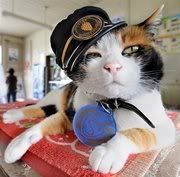 Tama
Because of budget cuts, the only stationmaster the Kishigawa Train Line in Japan can afford is Tama, a nine-year-old cat.
The railway company formally appointed her as "stationmaster" in January 2007. Happy with her successful job as stationmaster, the company promoted Tama to "super-stationmaster" in January this year, making her "the only female in a managerial position" in the company's 36-strong workforce. The company feeds her in lieu of salary.
Tama
Because of budget cuts, the only stationmaster the Kishigawa Train Line in Japan can afford is Tama, a nine-year-old cat.
The railway company formally appointed her as "stationmaster" in January 2007. Happy with her successful job as stationmaster, the company promoted Tama to "super-stationmaster" in January this year, making her "the only female in a managerial position" in the company's 36-strong workforce. The company feeds her in lieu of salary.
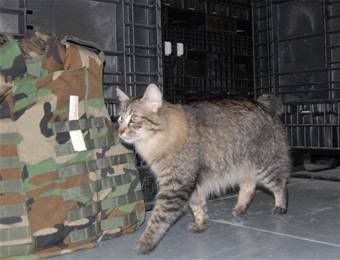 Wizzo
Fighting the war on rodent infestation, the 95th Mission Support Group is using a "military working cat" to help reduce the amount of damage to equipment caused by rodents living in the supply warehouse.
The cat, named Wizzo, calls the 95th Mission Support Group's supply warehouse his home. The feline lives and works around the clock as a mobility rodent deterrent.
So far, Wizzo has caught a bird, a rat and three mice, which officially makes him an ace. The supply team keeps his kill count posted on a board for him.
Wizzo
Fighting the war on rodent infestation, the 95th Mission Support Group is using a "military working cat" to help reduce the amount of damage to equipment caused by rodents living in the supply warehouse.
The cat, named Wizzo, calls the 95th Mission Support Group's supply warehouse his home. The feline lives and works around the clock as a mobility rodent deterrent.
So far, Wizzo has caught a bird, a rat and three mice, which officially makes him an ace. The supply team keeps his kill count posted on a board for him.
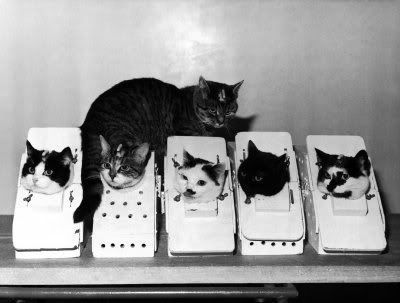 Felix , or was it Félicette?
France launched a black and white stray tomcat of the Paris streets on October 18, 1963, on Veronique AGI sounding rocket No. 47 from the Hammaguir test range in Algeria. Was it a male named Felix. Or a female named Félicette?
Whichever, it was the first cat in space as the capsule in the rocket's nose cone separated at 120 miles altitude and descended by parachute. Electrodes in the cat's brain transmitted neurological impulses to a ground station. The cat was recovered.
Photo: Cats in simulated spacesuits [NASA archive]
Thanks to LA Unleashed for tips to the Ruby and Tama stories.
Felix , or was it Félicette?
France launched a black and white stray tomcat of the Paris streets on October 18, 1963, on Veronique AGI sounding rocket No. 47 from the Hammaguir test range in Algeria. Was it a male named Felix. Or a female named Félicette?
Whichever, it was the first cat in space as the capsule in the rocket's nose cone separated at 120 miles altitude and descended by parachute. Electrodes in the cat's brain transmitted neurological impulses to a ground station. The cat was recovered.
Photo: Cats in simulated spacesuits [NASA archive]
Thanks to LA Unleashed for tips to the Ruby and Tama stories.
I wish I had one in my yard
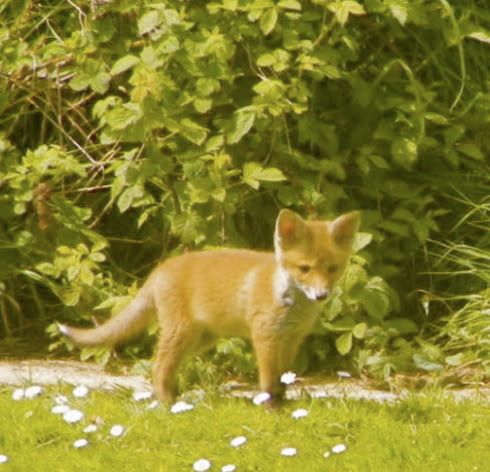 Jo in England, sent Chris a picture of one of the 13 fox cubs in her garden. There's one more photo.
Bear spotted taking a dip at the Hard Rock pool in Orlando
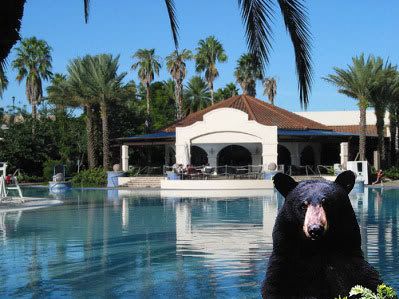 Orlando police are at Universal Studios, looking for a bear seen taking a dip in the pool at the Hard Rock Hotel.
abcNews reports that officers believe the young black bear is hiding out or sleeping in a wooded area on the Hard Rock Hotel property. Florida Fish and Wildlife is asking anyone who sees the bear to stay away and they're begging people not to go out looking for him.
Photo: HotelChatter
Orlando police are at Universal Studios, looking for a bear seen taking a dip in the pool at the Hard Rock Hotel.
abcNews reports that officers believe the young black bear is hiding out or sleeping in a wooded area on the Hard Rock Hotel property. Florida Fish and Wildlife is asking anyone who sees the bear to stay away and they're begging people not to go out looking for him.
Photo: HotelChatter
Wednesday, May 28, 2008
How to save money on pet stuff
Janet Huey e-mailed me to let me know about the pet related business she runs.
"I think I'm the only business of its kind in the US. I buy and sell new and used pet supplies and been doing so since 1997. All items are disinfected and cat furniture is isolated for 90 days since carpet can't be totally cleaned. I don't ship because Houston Texas is plenty big enough for me. I've combined 22 years of rescue with a business I love and saving people money as well as keeping things out of landfills."Janet's business is Pet Stuff Resale. Pet Stuff Resale is in the Houston area - what an excellent way to save money on pet items!
Tuesday, May 27, 2008
Book Review: Dog Park Wisdom
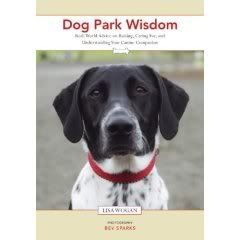 The title is misleading. Dog Park Wisdom
Monday, May 26, 2008
Video: Borneo Apes - Malaysia
By some estimates, Borneo's vast forests are being cleared faster than the Amazon. Unless something is done now, Orangutans could be extinct in 20 years. The practice of bulldozing everything to make way for palm oil plantations has left Orang-utans without their customary habitat. Lone Droescher-Nieslen from the Orangutan Survival Foundation hopes she can rehabilitate the Orangutans back into the wild. But if the rate of deforestation continues, there may soon be no forests to release them into... Watch the video
Cute or not? Baby crocodile
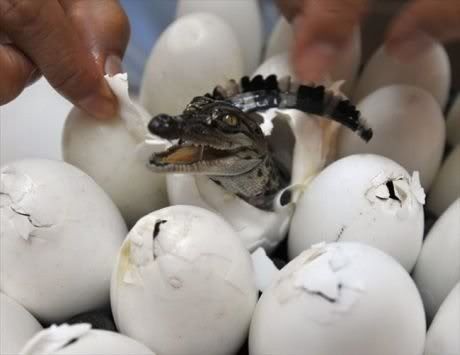 Can't decide? Here's another one . . .
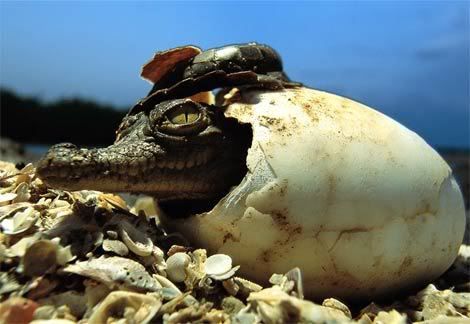 Photo: Steve Winter (National Geographic)
Saturday, May 24, 2008
Video: Making of Bunny Ads
Premise: Film a new commercial for Kiinteistömaailma, a Finnish real estate broker company, featuring a bunch of bunnies. Watch the video You can also watch the final, finished version. (via plime)
Friday, May 23, 2008
The loveable walrus
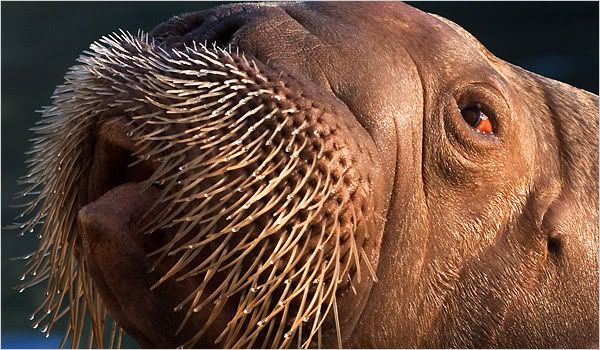 Dolphins are adored, whales revered, and seal pups make old Bond girls swoon. But walruses remain perversely, lumpishly obscure, known mostly for their sing-song linkage with a carpenter, an eggman and goo goo goo joob.
Odobenus rosmarus is a magnificent creature, behaviorally, anatomically, acoustically and taxonomically in a category all its own. The walrus belongs to the pinniped suborder, the group of blubbery, fin-footed carnivores that includes seals and sea lions.
Scientists are gathering evidence that the walrus is the most cognitively and socially sophisticated of all pinnipeds. Evidence suggests that the bonds between walruses are exceptionally strong: the animals share food, come to one another’s aid when under attack and nurse one another’s young. Walruses like to sing. Males woo females with lengthy compositions that have been compared in the complexity of their structure and phrasing to the songs of nightingales and humpback whales.
Source: The New York Times
(via Look at this)
Dolphins are adored, whales revered, and seal pups make old Bond girls swoon. But walruses remain perversely, lumpishly obscure, known mostly for their sing-song linkage with a carpenter, an eggman and goo goo goo joob.
Odobenus rosmarus is a magnificent creature, behaviorally, anatomically, acoustically and taxonomically in a category all its own. The walrus belongs to the pinniped suborder, the group of blubbery, fin-footed carnivores that includes seals and sea lions.
Scientists are gathering evidence that the walrus is the most cognitively and socially sophisticated of all pinnipeds. Evidence suggests that the bonds between walruses are exceptionally strong: the animals share food, come to one another’s aid when under attack and nurse one another’s young. Walruses like to sing. Males woo females with lengthy compositions that have been compared in the complexity of their structure and phrasing to the songs of nightingales and humpback whales.
Source: The New York Times
(via Look at this)
Isn't this all getting out of control?
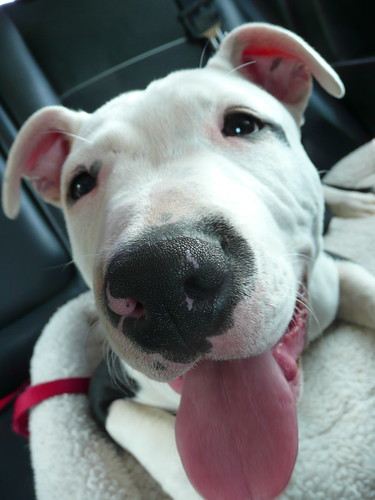 The small town of Osceola, NE is considering a breed ban that would ban American Pit Bull Terriers. The town has exactly one APBT, who has never caused any problems whatsoever and has no complaints registered against her.
Maggie, the only pit bull in town, lives across the street from Renee and Kent Johansen and their three children. The Johansens are leading the move for the ban. The Johansens, say they are concerned about the safety of their young children living in such close proximity to the pit bull.
“I know that specific dog has not done anything yet,” Renee Johansen said in a phone interview.
Maggie's owners, however, have purchased a $100,000 liability insurance policy, a stake that could not be pulled out of the ground, shortened her chain, got her a muzzle and the signs that were needed. They're trying to find a picture sign that warns about dogs for kids who can’t read.
The Osceola council says it wants to do the right thing and not make a law that squarely impacts one person, so they are banning 7 breeds of dogs: Staffordshire Bull Terrier, American Pit Bull Terrier, Am. Staffordshire Terrier, Chows, Dobermans, Rottweiler, American Bandage Mastiff, Neopolitan Mastiff, and any dog with the appearance of any of the above. American Bandage Mastiff? Just in case there is one, somewhere in the world.
(via For Your Entertainment)
Photo: nestmaker
The small town of Osceola, NE is considering a breed ban that would ban American Pit Bull Terriers. The town has exactly one APBT, who has never caused any problems whatsoever and has no complaints registered against her.
Maggie, the only pit bull in town, lives across the street from Renee and Kent Johansen and their three children. The Johansens are leading the move for the ban. The Johansens, say they are concerned about the safety of their young children living in such close proximity to the pit bull.
“I know that specific dog has not done anything yet,” Renee Johansen said in a phone interview.
Maggie's owners, however, have purchased a $100,000 liability insurance policy, a stake that could not be pulled out of the ground, shortened her chain, got her a muzzle and the signs that were needed. They're trying to find a picture sign that warns about dogs for kids who can’t read.
The Osceola council says it wants to do the right thing and not make a law that squarely impacts one person, so they are banning 7 breeds of dogs: Staffordshire Bull Terrier, American Pit Bull Terrier, Am. Staffordshire Terrier, Chows, Dobermans, Rottweiler, American Bandage Mastiff, Neopolitan Mastiff, and any dog with the appearance of any of the above. American Bandage Mastiff? Just in case there is one, somewhere in the world.
(via For Your Entertainment)
Photo: nestmaker
Coming soon: beetle mania?
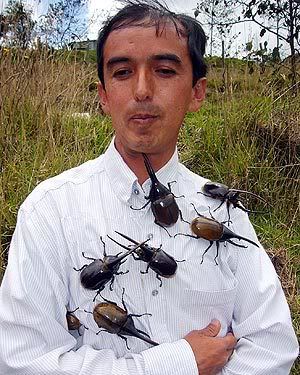 Cooing softly in baby talk, German Viasus gently uses a toothbrush to bathe the little animal he has raised since infancy and then pampers it with a fresh meal of mango, bananas and melon. The object of his affection? A beetle the size of a hamster with a hard, shiny shell and 2-inch-long horns.
Pictured is Viasus of Tunja, Colombia, showing off some of his Hercules beetles, which he exports to Asia for pets. Male Hercules beetles can grow to 7 inches and weigh as much as a hamster. Viasus ships giant, exotic types of the insects by the hundreds each month to Japan and elsewhere.
Source: Los Angeles Times
(via LA Unleashed)
Cooing softly in baby talk, German Viasus gently uses a toothbrush to bathe the little animal he has raised since infancy and then pampers it with a fresh meal of mango, bananas and melon. The object of his affection? A beetle the size of a hamster with a hard, shiny shell and 2-inch-long horns.
Pictured is Viasus of Tunja, Colombia, showing off some of his Hercules beetles, which he exports to Asia for pets. Male Hercules beetles can grow to 7 inches and weigh as much as a hamster. Viasus ships giant, exotic types of the insects by the hundreds each month to Japan and elsewhere.
Source: Los Angeles Times
(via LA Unleashed)
Thursday, May 22, 2008
White-handed Gibbons Now Presumed Extinct
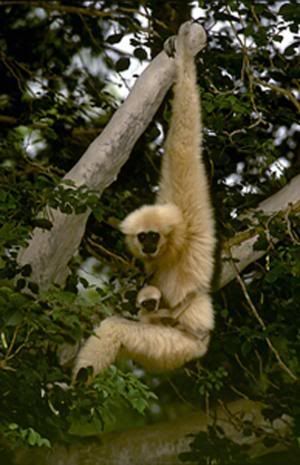 China's fauna exhibits a unique diversity of apes. Unfortunately, the apes are more seriously endangered by extinction in China than in any other country. A research team assembled by anthropologists of Zurich University now conclude that another ape species has just become extinct in China's Yunnan province.
Science Daily reports that the 14-member scientific team recently carried out a survey in all Chinese forests. They could not locate a single Yunnan white-handed gibbon. The last time this ape was observed in China was in 1988 at the Nangunhe Nature Reserve in south-western Yunnan province. Their loud, melodious calls were last heard in 1992. This subspecies (Hylobates lar yunnanensis) is not known from any other place.
Luckily, these apes are not lost to us forever. Several zoos have included them in their programs. One is the Honolulu Zoo. On their web page, you can hear the call of the white-handed gibbon:
listen
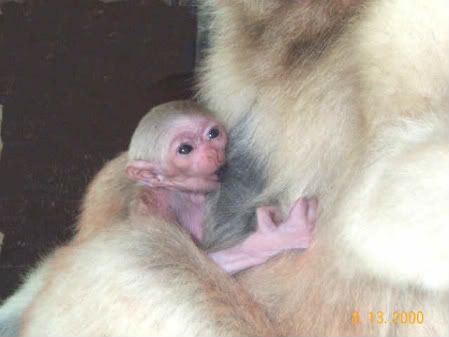
You can also see pictures of Emma, an adorable baby white-handed gibbon, born in 2000. Here's a picture of Emma, 7 hours after birth.
China's fauna exhibits a unique diversity of apes. Unfortunately, the apes are more seriously endangered by extinction in China than in any other country. A research team assembled by anthropologists of Zurich University now conclude that another ape species has just become extinct in China's Yunnan province.
Science Daily reports that the 14-member scientific team recently carried out a survey in all Chinese forests. They could not locate a single Yunnan white-handed gibbon. The last time this ape was observed in China was in 1988 at the Nangunhe Nature Reserve in south-western Yunnan province. Their loud, melodious calls were last heard in 1992. This subspecies (Hylobates lar yunnanensis) is not known from any other place.
Luckily, these apes are not lost to us forever. Several zoos have included them in their programs. One is the Honolulu Zoo. On their web page, you can hear the call of the white-handed gibbon:
listen
You can also see pictures of Emma, an adorable baby white-handed gibbon, born in 2000. Here's a picture of Emma, 7 hours after birth.
Cocks not welcome in Swaziland
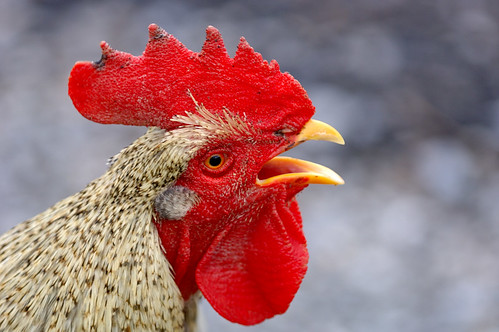 Authorities in Swaziland have declared war on roosters in the capital city because the birds are disrupting people's sleep. Authorities are set to enforce a 40-year-old law that permits residents to raise up to 12 chickens with permission but no roosters.
(Here's the quote of the week - ready?)
"After many instances we have found cocks to be troublesome and they end up making lives miserable for residents," said a Mbabane Municipal spokesman.
Source: AFP
Photo: Bill Shatto
Authorities in Swaziland have declared war on roosters in the capital city because the birds are disrupting people's sleep. Authorities are set to enforce a 40-year-old law that permits residents to raise up to 12 chickens with permission but no roosters.
(Here's the quote of the week - ready?)
"After many instances we have found cocks to be troublesome and they end up making lives miserable for residents," said a Mbabane Municipal spokesman.
Source: AFP
Photo: Bill Shatto
Pretty (smart) birds
Police in Japan rescued an African grey parrot two weeks ago from a roof in the city of Nagareyama, near Tokyo. After spending a night at the station, he was transferred to a nearby veterinary hospital while police searched for his owners.
After a few days with the vet, the parrot became chatty.
"I'm Mr. Yosuke Nakamura," the bird told the veterinarian.
The parrot also provided his full home address, down to the street number, and even entertained the hospital staff by singing songs.
Believable story!
Our own family's African grey parrot, Frankie, is also a well-versed conversationalist. He speaks both English and Italian and actually says things he has learned when the time is right. For example, when the phone rings, he says "Hello," and carries on a pretend (mumbled) conversation until he feels the call has been long enough, then says, "Thanks for calling. Bye-bye, now!"
When the doorbell rings, Frankie somehow knows who's outside even though he can't see them. He'll say, "Who's there, Julie?" when it's me.
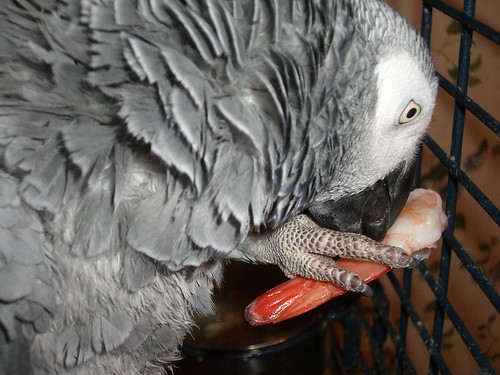 Frankie is an adventurous eater - he likes just about everything we eat. Favorites are chicken leg bones and biscotti, which he dunks in his water dish.
Often, he gets messy with his food. He'll pick up clawfulls of seeds and throw them. Then he says, "Stop that! I'm going to spank your butt!"
Photo: corsi photo (Of Frankie tasting shrimp for the first time.)
Frankie is an adventurous eater - he likes just about everything we eat. Favorites are chicken leg bones and biscotti, which he dunks in his water dish.
Often, he gets messy with his food. He'll pick up clawfulls of seeds and throw them. Then he says, "Stop that! I'm going to spank your butt!"
Photo: corsi photo (Of Frankie tasting shrimp for the first time.)
A rare vintage
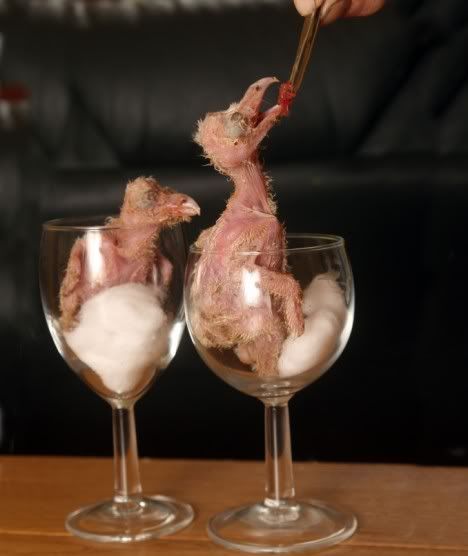 These are barn owl chicks, being fed by George Hedges. Hedges, of Devons Eagles, finds this the easiest method to give the fragile babies their daily morsels of food - mouse and cockerel chicks.
Source: MailonLine
These are barn owl chicks, being fed by George Hedges. Hedges, of Devons Eagles, finds this the easiest method to give the fragile babies their daily morsels of food - mouse and cockerel chicks.
Source: MailonLine
Wednesday, May 21, 2008
No kidding!
 Police thought they had a goat surrounded after it was spotted going the wrong way on the Cross Island Parkway. An ambulance and fire engine blocked traffic Monday while sheriff's deputies tried to corral the animal on the Charles E. Fraser Bridge, but she jumped.
Fire Battalion Chief Cliff Steedley told The Island Packet of Hilton Head Island the frightened goat plunged as much as 50 feet into Broad Creek.
Rescuers borrowed a boat to get the 70-pound nanny out of the waist-deep pluff mud as it worked its way through the marsh. One firefighter got stuck in the mud and had to be rescued.
Veterinarian Frank Murphy said the goat was fine after the smelly mud was washed off and there has been at least one offer to adopt it.
Police thought they had a goat surrounded after it was spotted going the wrong way on the Cross Island Parkway. An ambulance and fire engine blocked traffic Monday while sheriff's deputies tried to corral the animal on the Charles E. Fraser Bridge, but she jumped.
Fire Battalion Chief Cliff Steedley told The Island Packet of Hilton Head Island the frightened goat plunged as much as 50 feet into Broad Creek.
Rescuers borrowed a boat to get the 70-pound nanny out of the waist-deep pluff mud as it worked its way through the marsh. One firefighter got stuck in the mud and had to be rescued.
Veterinarian Frank Murphy said the goat was fine after the smelly mud was washed off and there has been at least one offer to adopt it.
Whose bed is it?
There's a rather well known joke among pet owners, The Dog Rules, which states: The dog never sleeps on the bed. Period.
- Ok, the dog can sleep at the foot of the bed only.
- Ok, the dog can sleep along side you, but he is not allowed under the covers.
- Ok, the dog can sleep under the covers, but not with his head on your pillow.
- Ok, the dog can sleep along side you, under the covers with his head on your pillow, but if he snores, he's got to leave the room.
- Ok, the dog can sleep and snore and fart and have nightmares in your bed, but he's not to come in and sleep on the couch in the TV room, where you're now sleeping. That's just not fair.
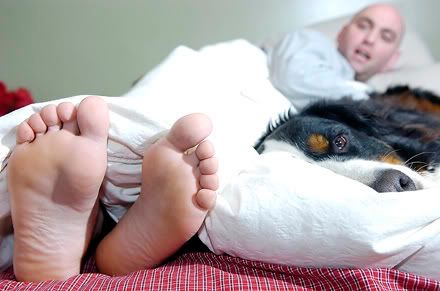 Scientists who study dogs say the animals have lived inside people’s homes since at least the 1400s. But no one is really sure when or why dogs began sleeping in people’s beds. In most places on Earth, the practice is considered filthy to this day.
Yet it is a common, if unreported, phenomenon for many dog owners in the United States.
In "Dogs in Bed," Last Exit magazine explores the complex issue of whether you should sleep with your dog, and the effect that choosing to do so may have on your social and sex life. It's humorously written by Michael Dinan, with gorgeous photos by Keelin Daly.
photo: Keelin Daly
Thanks, Keach
Scientists who study dogs say the animals have lived inside people’s homes since at least the 1400s. But no one is really sure when or why dogs began sleeping in people’s beds. In most places on Earth, the practice is considered filthy to this day.
Yet it is a common, if unreported, phenomenon for many dog owners in the United States.
In "Dogs in Bed," Last Exit magazine explores the complex issue of whether you should sleep with your dog, and the effect that choosing to do so may have on your social and sex life. It's humorously written by Michael Dinan, with gorgeous photos by Keelin Daly.
photo: Keelin Daly
Thanks, Keach
Tuesday, May 20, 2008
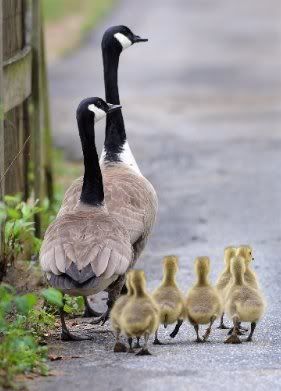
Book Review: Yorkie Doodle Dandy
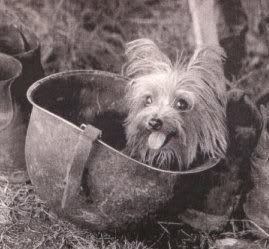 21-year-old American Air Force Private First Class William A. Wynne, stationed in New Guinea during World War II, met and fell in love with with Smoky, a Yorkshire Terrier pup.
The story told in Yorkie Doodle Dandy
21-year-old American Air Force Private First Class William A. Wynne, stationed in New Guinea during World War II, met and fell in love with with Smoky, a Yorkshire Terrier pup.
The story told in Yorkie Doodle Dandy
Compassion for feral cats
Feral cats — nearly invisible and often reviled — have prowled into the spotlight.
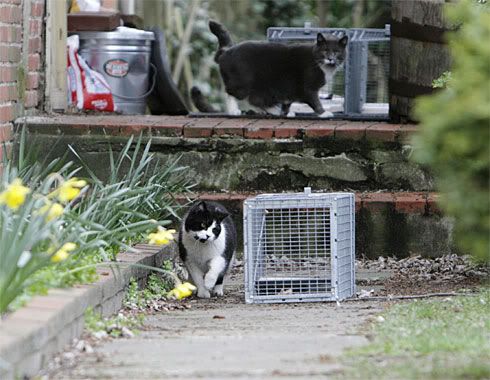 The free-roamers with an aversion to humans have grabbed headlines this spring because of a bounty on their heads in Iowa, a threatened roundup and disposal in Fairfax County, Va., and other elimination plans across the country.
But the cats also are receiving attention of a different sort.
Grass-roots groups and animal-welfare organizations are directing money and energy toward helping the tens of millions of feral cats that skulk about college campuses, cluster around back-alley trash bins, swarm among the rocks at beach communities and colonize the nether-reaches of suburban parks, military installations and abandoned barns and fields.
According to Neighborhood Cats, a "feral" cat is one who has reverted in some degree to a wild state. They originate from former domestic cats who were lost or abandoned and then learned to live outdoors or in environments involving little human contact.
TNR (trap/neuter/return) respects a feral cat's wild state. The neutering of the ferals prevents tremendous suffering and shields the cats from the hostility their behavior might otherwise draw from human neighbors. But the return of them to their own territory and the providing of adequate food and shelter gives them the opportunity to live among their own, to be free and to answer to their own unique natures.
This method thwarts future litters and reduces the yowling, spraying and fighting that annoy humans. In the process, the cats usually are vaccinated, treated for minor problems and given a notch in the ear to identify they are sterile. Over time, the colony will grow smaller through attrition.
For a list of organizations with programs to benefit feral cats, see the USA Today article, Compassion often eludes feral cats; groups out to save them, by Sharon L. Peters.
Photo: Joan Fairman Kanes for USA TODAY
The free-roamers with an aversion to humans have grabbed headlines this spring because of a bounty on their heads in Iowa, a threatened roundup and disposal in Fairfax County, Va., and other elimination plans across the country.
But the cats also are receiving attention of a different sort.
Grass-roots groups and animal-welfare organizations are directing money and energy toward helping the tens of millions of feral cats that skulk about college campuses, cluster around back-alley trash bins, swarm among the rocks at beach communities and colonize the nether-reaches of suburban parks, military installations and abandoned barns and fields.
According to Neighborhood Cats, a "feral" cat is one who has reverted in some degree to a wild state. They originate from former domestic cats who were lost or abandoned and then learned to live outdoors or in environments involving little human contact.
TNR (trap/neuter/return) respects a feral cat's wild state. The neutering of the ferals prevents tremendous suffering and shields the cats from the hostility their behavior might otherwise draw from human neighbors. But the return of them to their own territory and the providing of adequate food and shelter gives them the opportunity to live among their own, to be free and to answer to their own unique natures.
This method thwarts future litters and reduces the yowling, spraying and fighting that annoy humans. In the process, the cats usually are vaccinated, treated for minor problems and given a notch in the ear to identify they are sterile. Over time, the colony will grow smaller through attrition.
For a list of organizations with programs to benefit feral cats, see the USA Today article, Compassion often eludes feral cats; groups out to save them, by Sharon L. Peters.
Photo: Joan Fairman Kanes for USA TODAY
Monday, May 19, 2008
Molly, an amazing horse
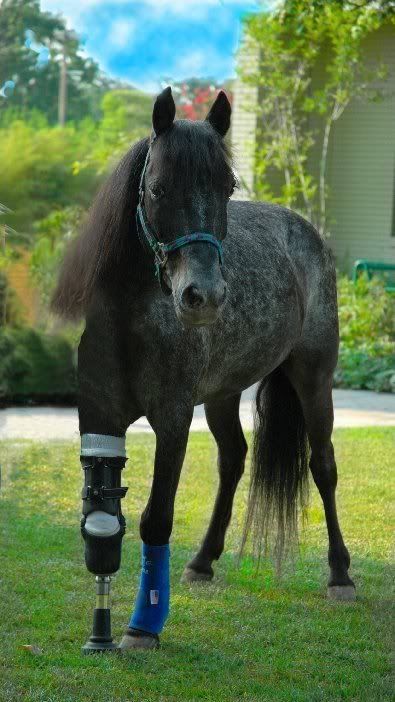
Molly is a gray speckled pony who was abandoned by her owners when Katrina hit southern Louisiana, USA.
She spent weeks on her own before finally being rescued and taken to a farm where abandoned animals were stockpiled. While there, she was attacked by a pit bull terrier, and almost died.
Her gnawed right front leg became infected and her vet went to LSU for help. But LSU was overwhelmed, and this pony was a welfare case. But after surgeon Rustin Moore met Molly, he changed his mind. He saw how the pony was careful to lie down on different sides so she didn't seem to get sores, and how she allowed people to handle her.
Moore agreed to remove her leg below the knee and a temporary artificial limb was built. Molly walked out of the clinic and her story really begins there.
 Molly happened to be a one-in-a-million patient. She's tough as nails, but sweet, and she was willing to cope with pain. The other important factor is having a truly committed owner who is dedicated to providing the daily care required over the lifetime of the horse.
Molly's story turns into a parable for life in post-Katrina Louisiana . The little pony gained weight, her mane felt a comb. A human prosthesis designer built her a leg.
The prosthetic has given Molly a whole new life, Allison Barca DVM, Molly's regular vet, reports.
(via reddit)
Molly happened to be a one-in-a-million patient. She's tough as nails, but sweet, and she was willing to cope with pain. The other important factor is having a truly committed owner who is dedicated to providing the daily care required over the lifetime of the horse.
Molly's story turns into a parable for life in post-Katrina Louisiana . The little pony gained weight, her mane felt a comb. A human prosthesis designer built her a leg.
The prosthetic has given Molly a whole new life, Allison Barca DVM, Molly's regular vet, reports.
(via reddit)
Sturgeon having a ball in Columbia River
 When sonar surveys spotted a vast pile of rubble in the Columbia River below Bonneville Dam late last winter, officials suddenly worried part of the dam structure was eroding into the river.
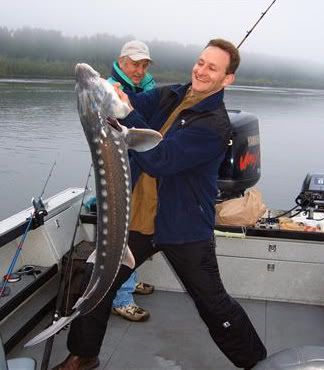
What they found below the spillways in February was not a giant pile of rock at all, but a humongous pile of thousands upon thousands of sturgeon - some of them 14 feet long or longer - lounging together in frigid water at the bottom of the river.
The mountain of white sturgeon contained around 60,000 fish, according to a crude estimate by Michael Parsley, a research fisheries biologist with the U.S. Geological Survey's Columbia River Research Laboratory in Cook, Wash. He described that estimate as "probably conservative."
It was an aquatic phenomenon nobody had ever seen at such a monstrous scale, offering a startling glimpse into the life of the Columbia's largest and most ancient fish.
Source: Oregon Live
Photo: Columbia River Trophy Sturgeon Fishing
When sonar surveys spotted a vast pile of rubble in the Columbia River below Bonneville Dam late last winter, officials suddenly worried part of the dam structure was eroding into the river.
What they found below the spillways in February was not a giant pile of rock at all, but a humongous pile of thousands upon thousands of sturgeon - some of them 14 feet long or longer - lounging together in frigid water at the bottom of the river.
The mountain of white sturgeon contained around 60,000 fish, according to a crude estimate by Michael Parsley, a research fisheries biologist with the U.S. Geological Survey's Columbia River Research Laboratory in Cook, Wash. He described that estimate as "probably conservative."
It was an aquatic phenomenon nobody had ever seen at such a monstrous scale, offering a startling glimpse into the life of the Columbia's largest and most ancient fish.
Source: Oregon Live
Photo: Columbia River Trophy Sturgeon Fishing
Sunday, May 18, 2008
Pet's Eye View Camera
 Did you ever wonder what your pet does all day while you're not home?
Now, with the Pet's Eye View Camera, you can take a photo at intervals of 1, 5 or 15 minutes just by attaching the gadget to your pet's collar.
$47.95 from Discover This
Did you ever wonder what your pet does all day while you're not home?
Now, with the Pet's Eye View Camera, you can take a photo at intervals of 1, 5 or 15 minutes just by attaching the gadget to your pet's collar.
$47.95 from Discover This
Doorbells for Dogs - Pet Chime
Tired of your pet scratching the door to come in? Want to teach your dog or cat to tell you when it needs to go out? Then you're ready for the Pet Age Magazine product of the year: Pet Chime™.
The Pet Chime is a wireless doorbell that allows your pet to tell you when it wants to go out or come in to the house. Two piece device: a paw-shaped remote control transmitter and a receiver chime. Both components are FCC approved.
Doorbell works with both dogs and cats.
To activate a chime, pets simply step on or push the paw with its nose. Select from two chime sounds: a dog bark or traditional ding-dong.
$24.99 at Comfort House
via Trendhunter
Baby albino wallaby rejected by mom
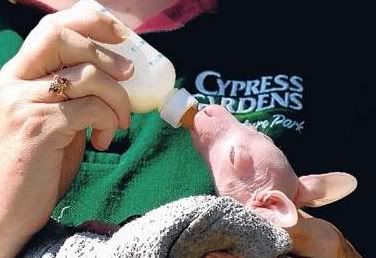 There's a new addition to the preemie ward at Cypress Gardens, and keepers are giving it around-the-clock care. An albino wallaby named Bela gave birth to an albino baby about four months ago.
In and of itself, the birth is pretty amazing -- albino wallabies are rare. Fewer than 10 have been born in the United States.
The new baby girl was supposed to stay in her mom's pouch until next winter, where she could nurse, grow fur, and get stronger. But fate stepped in.
There's a new addition to the preemie ward at Cypress Gardens, and keepers are giving it around-the-clock care. An albino wallaby named Bela gave birth to an albino baby about four months ago.
In and of itself, the birth is pretty amazing -- albino wallabies are rare. Fewer than 10 have been born in the United States.
The new baby girl was supposed to stay in her mom's pouch until next winter, where she could nurse, grow fur, and get stronger. But fate stepped in.
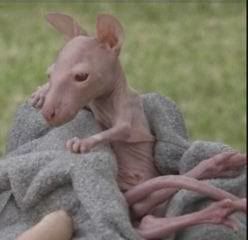 About a week and a half ago, a park employee found the new baby outside the pouch. Gardens officials are not sure what happened. They suspect that Bela may have been spooked, and threw the baby out. That's what wallaby moms do in the wild to save their own skins when they're threatened.
Since the baby is not even old enough to stand, it couldn't climb back in. Keepers tried to put it back in, but Bela would have no part of it.
"The mother growled at us. She didn't want anything to do with her," said Jessica Bond, an animal manager. "So it was in the baby's best interest to pull her and hand-raise her."
That's easier said than done. The baby, who hasn't been named yet, eats a few tablespoons of a special formula every three hours. Keepers, who take turns bringing the little one home, are up in the middle of the night feeding her.
Every other feeding they have to grease the baby with Vaseline, which simulates the mom licking her.
Gradually, the feedings will taper off. But she won't be fully weaned for another year.
Source: MyFox, Tampa Bay
About a week and a half ago, a park employee found the new baby outside the pouch. Gardens officials are not sure what happened. They suspect that Bela may have been spooked, and threw the baby out. That's what wallaby moms do in the wild to save their own skins when they're threatened.
Since the baby is not even old enough to stand, it couldn't climb back in. Keepers tried to put it back in, but Bela would have no part of it.
"The mother growled at us. She didn't want anything to do with her," said Jessica Bond, an animal manager. "So it was in the baby's best interest to pull her and hand-raise her."
That's easier said than done. The baby, who hasn't been named yet, eats a few tablespoons of a special formula every three hours. Keepers, who take turns bringing the little one home, are up in the middle of the night feeding her.
Every other feeding they have to grease the baby with Vaseline, which simulates the mom licking her.
Gradually, the feedings will taper off. But she won't be fully weaned for another year.
Source: MyFox, Tampa Bay
Octopus jewelry
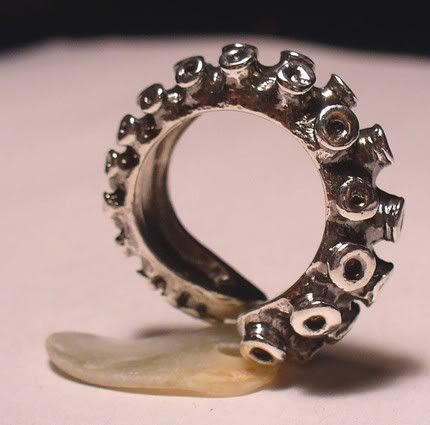 Like this beautiful bracelet, all of the octopus jewelry at the OctopusME! Store! has been made from REAL Sushi Grade Octopus and is SOLID Sterling silver with no Octopus remains in the jewelry.
wow
via Truemors
Like this beautiful bracelet, all of the octopus jewelry at the OctopusME! Store! has been made from REAL Sushi Grade Octopus and is SOLID Sterling silver with no Octopus remains in the jewelry.
wow
via Truemors
Saturday, May 17, 2008
Muddy Buddy Contest
Do you have a muddy buddy?
 Your pet could be the next Lee's Carpet spokespet!
If you think your pet has what it takes to represent the Lees brand, known for its exceptional durability, incredible stain repellency and 25-year wear warranty, submit a picture of your pet at his or her messiest. Entries will be accepted from May 1, 2008 until June 15, 2008. Starting on June 18, 2008 we will have five finalists online for voting. Be sure to check back and make sure your favorite Muddiest Buddy wins!
Your pet could be the next Lee's Carpet spokespet!
If you think your pet has what it takes to represent the Lees brand, known for its exceptional durability, incredible stain repellency and 25-year wear warranty, submit a picture of your pet at his or her messiest. Entries will be accepted from May 1, 2008 until June 15, 2008. Starting on June 18, 2008 we will have five finalists online for voting. Be sure to check back and make sure your favorite Muddiest Buddy wins!
Video: Schmitty, Political Pooch
Schmitty, the Real New Yorkie has a lot to "bark" about with the BARK THE VOTE campaign. Doesn't matter if your candidate du jour is Obama, Hillary, or McCain. We just want everyone to "Be A Party Animal" and get all the humans in the USA to register and vote in this upcoming presidential election. Join the canine caucus. Make a difference. BARK THE VOTE. Watch the video. Thanks, Chad.
Friday, May 16, 2008
What a dog!
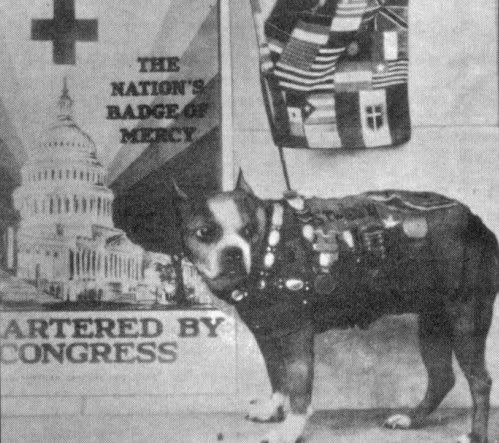 Sergeant Stubby, a Bull Terrier mix, is the single most decorated dog in U.S. history.
He was picked up as a stray in 1917, by Private J. Robert Conroy when the homeless dog appeared at the training camp of the 102nd Infantry at Yale University. Conroy and buddies kept Stubby with them through all their drills and training and, in July 1917, when it came time to ship out for France, they smuggled Stubby aboard ship.
Within weeks of their arrival in the European theatre, the 102nd was under fire on the front lines in France. The boom of artillery fire didn't faze Stubby in the least, and the men learned of incoming bombs by watching him. Stubby could hear the whine of shells long before the men.
For 18 months Stubby carried messages under fire, stood sentry duty, and helped paramedics find the wounded in “no man’s land”. He gave early warning of deadly gas attacks and was credited many times with saving his entire regiment. When Stubby found and helped capture a German spy who was mapping a layout of the Allied trenches, he was awarded the honorary rank of Sergeant - the first dog to be given rank in the U.S. Armed Forces. When seriously wounded by shrapnel, he was sent to the Red Cross hospital for surgery just like any other soldier. Once recovered, Stubby returned to his regiment and continued to serve until November 11, 1918, the day the war ended.
Named a life member of the Red Cross and the American Legion, Stubby was awarded many medals including one by General John J. Pershing. Called to the White House several times to meet Presidents Harding and Coolidge, he led more regimental parades than any other dog in history.
Stubby spent his final years with John Conroy, the soldier who had rescued him so many years ago. He died of old age in 1926. Stubby's remains were preserved with technical assistance from the Smithsonian Institution. Stubby, his medals and personal effects were donated to the Smithsonian by Conroy and can still be seen there.
Sergeant Stubby, a Bull Terrier mix, is the single most decorated dog in U.S. history.
He was picked up as a stray in 1917, by Private J. Robert Conroy when the homeless dog appeared at the training camp of the 102nd Infantry at Yale University. Conroy and buddies kept Stubby with them through all their drills and training and, in July 1917, when it came time to ship out for France, they smuggled Stubby aboard ship.
Within weeks of their arrival in the European theatre, the 102nd was under fire on the front lines in France. The boom of artillery fire didn't faze Stubby in the least, and the men learned of incoming bombs by watching him. Stubby could hear the whine of shells long before the men.
For 18 months Stubby carried messages under fire, stood sentry duty, and helped paramedics find the wounded in “no man’s land”. He gave early warning of deadly gas attacks and was credited many times with saving his entire regiment. When Stubby found and helped capture a German spy who was mapping a layout of the Allied trenches, he was awarded the honorary rank of Sergeant - the first dog to be given rank in the U.S. Armed Forces. When seriously wounded by shrapnel, he was sent to the Red Cross hospital for surgery just like any other soldier. Once recovered, Stubby returned to his regiment and continued to serve until November 11, 1918, the day the war ended.
Named a life member of the Red Cross and the American Legion, Stubby was awarded many medals including one by General John J. Pershing. Called to the White House several times to meet Presidents Harding and Coolidge, he led more regimental parades than any other dog in history.
Stubby spent his final years with John Conroy, the soldier who had rescued him so many years ago. He died of old age in 1926. Stubby's remains were preserved with technical assistance from the Smithsonian Institution. Stubby, his medals and personal effects were donated to the Smithsonian by Conroy and can still be seen there.
Great advertising
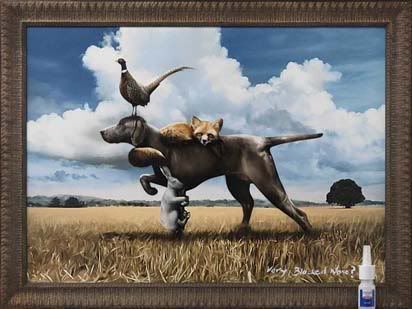 "Blocked nose?"
Ad agency Saatchi & Saatchi in Milan has created a great series of ads for Otrivin nose spray.
--- I love the humor.
More photos at I believe in advertising.
"Blocked nose?"
Ad agency Saatchi & Saatchi in Milan has created a great series of ads for Otrivin nose spray.
--- I love the humor.
More photos at I believe in advertising.
Little piggies saved from the market
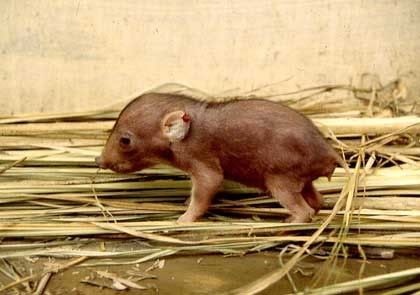 The world’s smallest and rarest pig, which was once feared extinct, is ready to re-enter the wild again.
Pygmy hogs were thought to have been wiped out in the 1960s until two small populations were found in northern Assam in India in 1971. After a 13-year captive breeding program led by Durrell Wildlife, the Jersey-based conservation centre founded by the author Gerald Durrell, the descendants of those surviving hogs are being reintroduced to their natural habitat at the foot of the Himalayas.
The 16 hogs due to return to the wild - taken from a captive population of only 79 - have been kept in large pre-release enclosures that replicate their natural habitat for the past five months and have become progressively shyer, their keepers say. “Up to release date, the hogs have shown naturalistic behavior and an aversion to human contact, which is a positive sign that they will fair well when released.”
Source: Times Online
(via Boing Boing)
The world’s smallest and rarest pig, which was once feared extinct, is ready to re-enter the wild again.
Pygmy hogs were thought to have been wiped out in the 1960s until two small populations were found in northern Assam in India in 1971. After a 13-year captive breeding program led by Durrell Wildlife, the Jersey-based conservation centre founded by the author Gerald Durrell, the descendants of those surviving hogs are being reintroduced to their natural habitat at the foot of the Himalayas.
The 16 hogs due to return to the wild - taken from a captive population of only 79 - have been kept in large pre-release enclosures that replicate their natural habitat for the past five months and have become progressively shyer, their keepers say. “Up to release date, the hogs have shown naturalistic behavior and an aversion to human contact, which is a positive sign that they will fair well when released.”
Source: Times Online
(via Boing Boing)
Thursday, May 15, 2008
Houston-area invaded by crazy rasberry ants
 The crazy Rasberry ants are marching! Hundreds, thousands, millions, billions of them are coming in a near-unstoppable zig-zagging insect army intent on making Houston homes, yards and lives a living hill.
First spotted in 2002 in Pasadena by Tom Rasberry, the exterminator for whom the rice-grain-sized insects are named, the ants now have spread through much of the greater Houston area. May through September is their peak period — a time when billions of the critters with a reluctance to sting and a habit of chewing up electrical wiring may infest a single acre. Homeowners daily sweep up dust bins of their dead and maimed.
While they are not prone to stinging humans, the ants do pose potentially serious problems. Ants indirectly can damage plants by establishing a symbiotic relationship with sap-sucking aphids. Ants feed on a sugary aphid excretion called honeydew and, therefore, protect the aphids from predators.
More significantly, crazy Rasberry ants have demonstrated a tendency to nest in and damage electric equipment.
Source: Houston Chronicle
Photo: Tom Rasberry, an exterminator, lets "crazy rasberry ants," named after him, crawl on his arm in Deer Park.
David J. Phillip: AP
The crazy Rasberry ants are marching! Hundreds, thousands, millions, billions of them are coming in a near-unstoppable zig-zagging insect army intent on making Houston homes, yards and lives a living hill.
First spotted in 2002 in Pasadena by Tom Rasberry, the exterminator for whom the rice-grain-sized insects are named, the ants now have spread through much of the greater Houston area. May through September is their peak period — a time when billions of the critters with a reluctance to sting and a habit of chewing up electrical wiring may infest a single acre. Homeowners daily sweep up dust bins of their dead and maimed.
While they are not prone to stinging humans, the ants do pose potentially serious problems. Ants indirectly can damage plants by establishing a symbiotic relationship with sap-sucking aphids. Ants feed on a sugary aphid excretion called honeydew and, therefore, protect the aphids from predators.
More significantly, crazy Rasberry ants have demonstrated a tendency to nest in and damage electric equipment.
Source: Houston Chronicle
Photo: Tom Rasberry, an exterminator, lets "crazy rasberry ants," named after him, crawl on his arm in Deer Park.
David J. Phillip: AP
Let's eat!
 Chicago's City Council has repealed the foie gras ban. It legal once again for city restaurants to serve up the delicacy made from duck and goose liver.
Mayor Richard Daley, who had once dismissed the ban as "the silliest law the City Council has ever passed," squelched debate on the measure and commanded the council to vote. The 37-6 vote repealed the 2-year-long ban.
Photo: Chuck T
Chicago's City Council has repealed the foie gras ban. It legal once again for city restaurants to serve up the delicacy made from duck and goose liver.
Mayor Richard Daley, who had once dismissed the ban as "the silliest law the City Council has ever passed," squelched debate on the measure and commanded the council to vote. The 37-6 vote repealed the 2-year-long ban.
Photo: Chuck T
Oh no, painted dogs!
At Dog Reflections, 15 Photos Of Dogs With Dye Jobs. I don't know why someone would want to dye their dog. The dogs certainly don't seem very happy. They look embarrassed, like this poor thing!
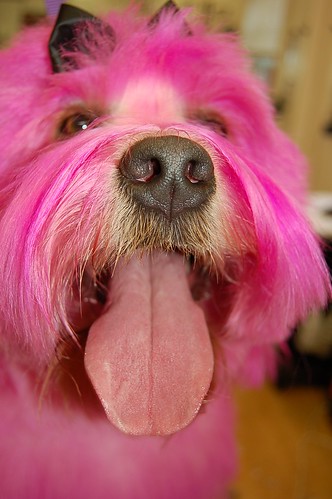 Photo by “jenny horror”
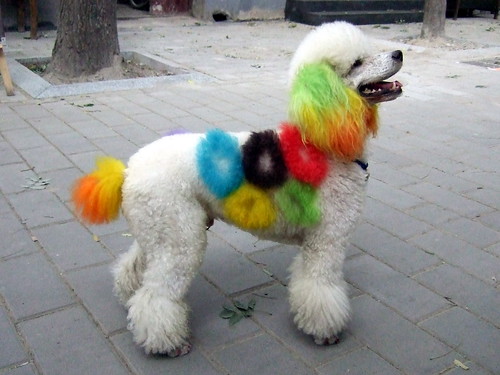 Photo by Zoom Zoom
Subscribe to:
Posts (Atom)