This guest post was provided to you by Jennifer. Jennifer is a dog enthusiast who enjoys caring for dogs, especially her own. She loves to talk with fellow dog owners and share tips or advice, while discovering new trends by working with Havahart Wireless, a pet product company.
Is Your Dog Sociable? How to Stop Barking Dogs with Dog Socialization
There is nothing more annoying than a dog that barks incessantly. This cannot only be very irritating and frustrating for dog owners, it can also destroy neighbor relations. While it is unrealistic to want to stop dogs barking completely – for that is how they express themselves – it is possible to both prevent, and stop, nuisance barking in dogs. Follow the advice below to learn how to prevent nuisance barking in dogs, and how to stop barking dogs from barking uncontrollably.
Proper Socialization
The key to preventing bad social behavior in dogs is to properly socialize your dog when it is still a puppy. Puppy socialization and training is essential to set boundaries, rules, and to develop social interactions and social rank within the family hierarchy. During puppy training your dog will learn to respect you as leader, and obey your commands. He will also gain confidence that will stand him in good stead throughout the rest of his life – this will prevent other social problems, such as separation anxiety, chewing and digging, fear and mistrust, and barking for attention or reward. Puppy socialization teaches your puppy social skills, both in the family setting, and when mixing with strangers and other dogs.
Leader of the Pack
First and foremost, your puppy must learn to recognize you as the pack leader, and respect your authority and commands. Proper training is generally achieved through conditioning – usually by providing a reward when commands are obeyed. The essential element is consistency. Your expressions must be consistent with your demands so as not to send out mixed messages, which will only confuse your dog. There are training devices that can be used to stop barking dogs, including bark collars, and electronic anti-bark devices, but ultimately, prevention is better than cure. By giving your puppy a good grounding with proper training and socializing, you will prevent undesirable behavior from developing from the onset, and will own a dog that is a pleasure to have around.
Social Skills
Take your dog out of the yard under the control of a leash so that he gets used to strange smells, and to other dogs. Visit the local park, dog park, or the beach with your dog so that he gets used to mingling with other canines. This will prevent aggressive barking and aggressive behavior towards other dogs developing from a young age.
Provide Companionship
Dogs are sociable pack animals and are generally don't enjoy being left in isolation for lengthy periods. It is important that you provide your dog with human or canine company rather than isolating him to the back yard on his own. If your dog is confined to the back yard on his own it will ultimately result in a bored, lonely, and unhappy dog that will inevitably resort to barking and whining to vent his frustration, or to seek attention. This is unfair and unkind, as you also have responsibilities to ensure that your dog is stimulated, and that his social needs are met.
If you have to leave your dog alone for long periods of time, make sure that he receives adequate attention and companionship when you are home. Try to walk your pooch daily to provide him with both physical and mental stimulation, as he struts down the road sniffing the curb for telltale signs left by the other dogs in the neighborhood as they passed by. Allow your dog to enter the home as a welcome member of the family when you return home from work.
If you want to know how to stop barking dogs, the answer is proper socialization and training, together with love, companionship and stimulation – this will result in a happy, well-balanced dog that will be your loyal companion.
Wednesday, July 18, 2012
Guest Post: How to Stop Barking Dogs with Dog Socialization


Friday, June 22, 2012
Guest Post: Cat Care 101: Dogs Aren't the Only Pet in Need of Training
Liz Becker is a blogger, freelance writer and recent college graduate. She
currently performs market research for an online marketing firm when she
is
not contributing her own thoughts and observations to the online
community.
Cat Care 101: Dogs Aren't the Only Pet in Need of Training
Sunday, June 17, 2012
Can All Dogs Swim?
With the hot "dog days" of summer quickly approaching, here's a timely question:
Q. Do dogs know how to swim naturally? If not, how can I teach my dog?
And a very helpful answer from Dr. Marty Becker at VetStreet:
A. Dogs will naturally start “dog paddling” when they find themselves in water, but that doesn’t mean that they can stay afloat for any length of time, that they like being in the water, or that they can safely swim.
Read the article to see if your dog is the swimming type and how to teach them to swim.
Thursday, June 14, 2012
When a dog bites a crawling baby or excited toddler, whose fault is it?
There are almost five million dog bites every year in the United
Statesand nearly one million require medical attention, according to the
Centers for Disease Control. There were 31 fatal dog attacks in the
United States in 2011, including a 15-day-old infant. You can read their
stories at www.dogsbite.org.
Most dogs bites are from dogs known to the victim, owned either by the victim’s family or neighbor.
When a dog bites a crawling baby or excited toddler, whose fault is it?
Dog owners are quick to say it wasn’t the dog’s fault, and they are right. It wasn’t the dog’s fault. The dog was being a dog,
and the toddler was being a toddler. Was it the owner’s fault for not
controlling their dog, or the parent’s fault for not supervising the
child?
Dr. Kathleen Berchelmann, a pediatrician with St. Louis Children’s Hospital, says there are key things you can do to prevent dog bites:
1) Never, ever put an infant or toddler on the floor with a dog.
2) Be sure that dogs cannot access children, especially infants, while they are sleeping.
3) Even if you do not own a dog, teach children age-appropriate
interactions with dogs. When teaching children how to approach a dog,
always be sure a dog is leashed and under an adult’s full control.
4) Teach children never to put their face at a dog’s level.
5) Do not approach an unfamiliar dog, even if it looks friendly.
6) Do not run from a dog or scream.
7) Remain motionless (e.g., “be still like a tree”) when approached by an unfamiliar dog.
8) If knocked over by a dog, roll into a ball and lie still (e.g., “be still like a log”).
9) Do not play with a dog unless supervised by an adult.
10) Immediately report stray dogs or dogs displaying unusual behavior to an adult.
11) Avoid direct eye contact with a dog.
12) Do not disturb a dog that is sleeping, eating, or caring for puppies.
13) Do not pet a dog without allowing it to see and sniff you first.
Thursday, April 14, 2011
Found on the Web
Underwater Aliens: The Beauty Down Below The animals of the deep ocean might as well be from a different planet. Here are some beautiful images of the some of the strangest creatures on earth. Deadly Bat Disease Spreading West White-nose syndrome has killed more than a million bats in the United States. Read about the startling crisis that's threatening whole populations of these creatures of the night. 10 Humane Ways to Discipline Your Dog Ten humane, and widely used, training techniques for dogs.
Friday, January 21, 2011
1,022 words - largest vocabulary of any known dog
 Chaser, a border collie who lives in Spartanburg, S.C., knows 1,022 proper nouns, a record that displays unexpected depths of the canine mind.
John W. Pilley, Chaser's owner, bought her as a puppy in 2004 from a local border collie breeder and started to train her for four to five hours a day. He would show her an object, say its name up to 40 times, then hide it and ask her to find it, while repeating the name all the time. She was taught one or two new names a day, with monthly revisions and reinforcement for any names she had forgotten.
It was hard to remember all the names Chase had to learn, so he wrote the name on each toy with indelible marker. In three years, Chaser's vocabulary included 800 cloth animals, 116 balls, 26 Frisbees and a medley of plastic items.
Source
Tuesday, March 3, 2009
Aggressive owner = aggressive dog
 A veterinary study shows that if you're aggressive, you're dog will be, too.
Duh - this just seems like common sense, doesn't it?
In a new, year-long University of Pennsylvania survey of dog owners who use confrontational or aversive methods to train aggressive pets, veterinary researchers have found that most of these animals will continue to be aggressive unless training techniques are modified.
Source
Thursday, January 8, 2009
Lucky in Seattle
 This weekend the Cesar and Ilusion Millan Foundation is participating in an event in Seattle.
Winterfest 2009 event includes:
• Appearance by Dog Whisperer Cesar Millan
• Singing performance by American Idol Blake Lewis
• Fashion Show
• Talent Competition “Next Dog Star” to compete for the most talented Dog Star in America, kicking off the entire competition in Seattle, Washington
• Vendor booths displaying products and services
• Guest Speakers on Dog Related Topics
Monday, November 24, 2008
Cesar Millan Seminar in Atlanta
 Cesar Millan's only 2008 seminar, will take place in Atlanta, GA. on Saturday, December 6th, at 2 PM.
The Seminar will be held at John A. Williams Theatre
at the Cobb Energy Performing Arts Centre
Premium tickets, which include a Meet-and-Greet with Cesar after the show, will be on sale for $250.
Regular tickets range from $150 - $25, depending on how far they are from the stage.
The star of the Emmy-nominated hit series Dog Whisperer brings his magic and wisdom about dogs and dog psychology to this unique live special event. Fans of the show and dog lovers alike will be immersed in Cesar's world for three compelling hours, as the best-selling author of Cesar's Way reveals his secrets to happier, healthier relationships between humans and their canine companions.
Details for Cesar's only 2008 Seminar
Wednesday, November 5, 2008
Pets and Seasonal Depression - Winter Weather Tips to Keep Your Pet Active and Healthy

Although you might be dreading harsh winter weather, it also can bring the blues for pets. According to a study by the veterinary charity People's Dispensary for Sick Animals (PDSA), similar to humans that suffer from Seasonal Affective Disorder, one in three dog owners sees a downturn in their pets’ moods during colder and darker months throughout the year. While humans have the opportunity to vacation in a warmer climate or take prescription medication, the solution for helping your pet can be as simple as providing a high quality diet and regular exercise. Stacy Peardot-Goudy, an award-winning agility trainer and Nature’s Variety Pet Nutrition Council member, suggests these tips to keep your dog or cat healthy this winter:
- Stair work – If you have a house with closed stairs, play fetch by throwing a toy up the stairs and having them run up and back down for a great work-out.
- Rotation Diet – Offering different forms (kibble, canned, raw) and proteins (meat, fish, poultry) such as the Nature’s Variety Rotation Diet, will keep your pet interested in eating and help with better behavior – which can help with being inside more often. Be sure to notice the amount of food you are feeding, since a pet is often less active in winter. By following a rotation diet, you pay more attention to what you are feeding your pet and decrease your chances of over-feeding.
- Obedience routines – Bring out the training books and work with your pet to improve basic skills such as heel work, turns, sit and stay. It will keep your pet mentally activity, which is just as important as physical activity, and increases pet/owner interaction.
- Hide and seek – Create a treasure hunt for your pet around the house by hiding treats in different places. This is an interactive game to get your pet moving and encourage them to explore their surroundings. Utilize your pet’s meal as treats by using kibble or a Nature’s Variety frozen raw medallion and calculate this into your pet’s daily feeding.
- Indoor pools – If you have access to an indoor pool or pet rehabilitation center, swimming is a great physical activity for dogs that is easy on joints. Start with short sessions and build up the duration and intensity of the swims.
Sunday, November 2, 2008
Learn to improve your dog's behavior
 Cesar Millan is highly respected for his unique insight into dog psychology and shows us how we can lead our dogs to behave and obey through our own confident energy, body language and positive reinforcement.
In this Cesar Millan's Mastering Leadership series

Monday, January 14, 2008
The Potty Rock - to train your dog
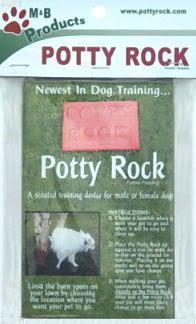 Place the Potty Rock™ in an area you want your dog to use for a designated potty area.
The potty rock is cast with a built in fragrance that is almost irresistible to canines, and makes potty training your dog a quick efficient process.
$14.95 at M & B Pet Products