Showing posts with label koalas. Show all posts

Tuesday, June 26, 2012

Guest Post: Animal Myths Busted! (part 2)

 Estelle Page is a blogger at www.gkbcinc.com, , and she’s on a mission to prove that everything we know about animals is a lie! Well, okay, just some of it...

This is Part Two of a post published June 6, 2012.

 5 More Infamous Animal Myths
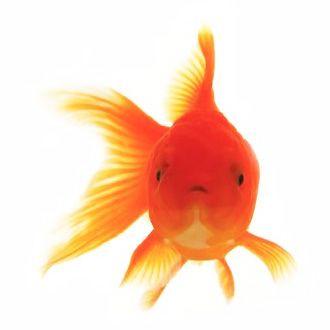
Image: AJ Cann
 Making up facts about animals seems to be one of our favourite pastimes.

The internet is swarming with so called ‘animal facts’ and it seems that there’s no shortage of misinformed animal lovers. This list sets out to reverse some of this bad work and set the record straight.

Read on for a few more daft suggestions that have been made about our animal friends.

1. Rats are ‘orrible and dirty

No, actually it all depends on the rat.
If the rat lives in a sewer, then yes, the rat is probably quite dirty. Generally speaking though, rats spend around 60% of their lives cleaning themselves. This means they only have 40% of their time to do other things, such as become dirty again.

2. Goldfish have a three second memory

One of my all time favourite incorrect animal myths is the memory capacity of a Goldfish.

In actual fact, Goldfish have quite good memories – they’ve proved they can be taught how to navigate a maze.

Sadly, many still have to live in a fish bowl with a miniature castle.

I’m not sure whose idea it was to associate Goldfish with underwater replicas of English middle aged fortifications, but it definitely seems to have caught on...
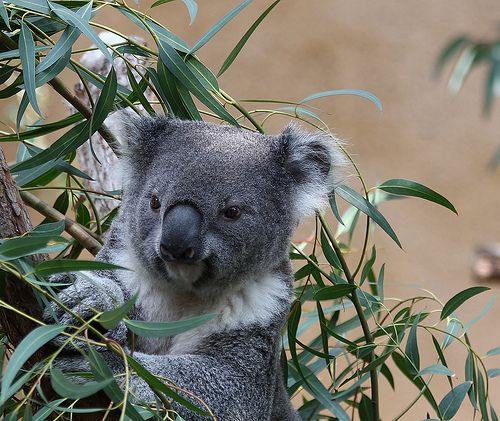
Image: Rennett Stowe
3. Koalas are bears

Koalas are a type of marsupial, not a kind of bear.

They are furry like bears, but that’s where the similarities end. English settlers have been awarded the responsibility of awarding the koala bear its incorrect label.

But English settlers gave quite a few pretty peculiar names around this time so maybe it was a trend back then.

4. Worms will regenerate

This is the type of thing your primary school teacher tells you and you believe for life, and you’ll end up passing this (incorrect) vital information down to your children:

“If you cut a worm in half, then the two halves will regenerate and continue to live as two separate worms.”

This is just not true.

Earthworms are biologically complex like other species. They have all the internal body systems that make up most other living organisms i.e. brains, digestive systems....the lot.

You wouldn’t cut a dolphin in half to see if it survived, would you?

My suggestions is to use the appropriate pest control supplies UK instead of waging war on the garden critters by punishing them through death.

You might also be interested to learn that a mole survives on a diet of only earthworms, so you could already have some help there if moles are a garden feature of yours.

Unless it’s the pesky moles that are the problem, in which case you might want to save the worms and invest in some sonic mole repeller instead.

Image: Suwaif

5. Camels store water in their humps

Let’s get this straight - a camel is not a live, walking hip flask.

A camel’s hump contains fat reserves providing the animal with the same amount of energy as three weeks of food do, so they’re more like packet lunch boxes than water bottles.

For animals, desert survival is about the preservation of water and nutrients within their bodies rather than actual storage for when they get a bit bored.

So, there you have your 5 more animal myths blown out of the water.

Your task is now to find some more to add to my list...

Friday, December 3, 2010

Koala Bears - cute & endangered

Most of us, by now, know that koala are not really "bears." But did you also know that koalas are social animals and can communicate with each other over long distances? But the most important fact about koalas is that the impact of intense urbanization has resulted in the destruction of their habitat, while the attacks of other animals, like domestic dogs and foxes, and traffic accidents, are causing the koala population to decline. Source: Environmental Graffiti

Monday, June 8, 2009

Australia's koalas at risk from inbreeding

The two largest populations of koalas in Australia are so heavily inbred that they could be wiped out "in an instant" by a single disease, scientists have warned. A recent study of the tree-dwelling marsupials on Kangaroo Island, which lies off the coast of South Australia, and French Island, off the south-east state of Victoria, revealed that the genetic make up of the koalas was dangerously similar. More than 20,000 koalas inhabit Kangaroo Island and somewhere between 2000 to 3000 on French Island, but the animals could be quickly wiped out if they were exposed to a disease, the study found. The inbreeding was the result of a relocation program that began more than a century ago. Source

Thursday, June 4, 2009

Weird news: Tourists find koala napping in bed

Three Australian women vacationing on an island off the coast of the mainland said they were shocked when a koala chose their hotel room bed for a nap. The koala entered the home from the balcony and settled for a nap on a bed covered with a blue and pink floral duvet. Source

Saturday, March 8, 2008

Tuesday, January 15, 2008

World's only blue-eyed koala

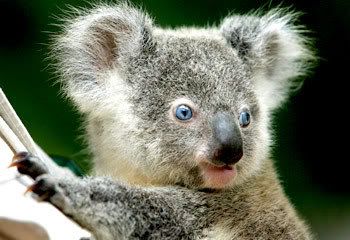
His piercing eyes have dumbfounded animal carers who were so worried they tested his vision. Staff at his Dreamworld home on the Gold Coast found that apart from some reduced pigmentation, Frankie, named after Frank Sinatra, has perfect vision. Frankie is the world's only known blue-eyed koala. Source: Daily Telegraph

Monday, September 24, 2007

Rare white koala

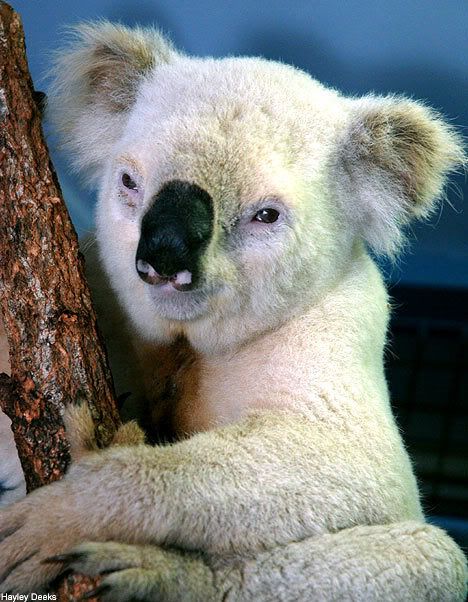
This koala is incredibly rare because although he has white fur instead of the usual grey/brown, he has the normal black eyes and nose. The creature, nicknamed Mick, was found blind and suffering from a variety of illnesses by a forest ranger and taken to the Port Macquarie Koala Hospital, north of Sydney. He was immediately given round-the-clock security protection in case anyone tried to steal him and sell him to a collector for his novelty value. After an operation on his eyes, he was put on antibiotics and gradually returned to full health. Mick has just been released back into the Bush after months of treatment - although his precise location remains a secret. (via)

Friday, August 3, 2007

Cute Baby Koala

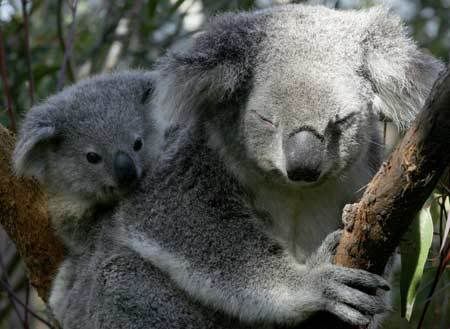
An adult female koala named "Tara", with her six-month-old joey clinging to her back, rests on an eucaplyptus tree at an animal park in Sydney July 31, 2007. The central Sydney animal park has seen the birth of three joeys (baby koalas) in the last seven-and-a-half months and is holding a competition for the public to name the baby koalas. (Xinhua/Reuters Photo)

Saturday, June 2, 2007

Studying a Koala Mystery in Eastern Australia

One of the best places in the world to learn about koalas is St. Bees Island off the coast of Queensland in eastern Australia. Decades ago, koalas were imported there to enhance tourism at a local resort. The resort is long gone, but the koalas stayed, and their presence has led to a new kind of visitor: research biologists such as Alistair Melzer. Melzer is studying the island's koalas, trying to understand why the iconic animal is thriving there, while on the verge of extinction in many other parts of Australia.

Tuesday, May 15, 2007

World's Only Twin Koalas

Mother Koala Murrumbidgee takes care of her Koala twins, who are six and a half months old, at Chimelong Xiangjiang Safari Park in Guangzhou, south China's Guangdong province May 13, 2007. It is currently the only pair of Koala twins surviving in the world, according to local media. REUTERS/Joe Tan

Monday, February 26, 2007

Australia rocked by 'lesbian' koala revelation

Female koalas indulge in lesbian "sex sessions", rejecting male suitors and attempting to mate with each other, sometimes up to five at a time, according to researchers. The furry, eucalyptus-eating creatures appear to develop this tendency for same-sex liaisons when they are in captivity. In the wild, they remain heterosexual. Scientists monitoring the marsupials with digital cameras counted three homosexual interactions for every heterosexual one. "Some females rejected the advances of males that were in their enclosures, only to become willing participants in homosexual encounters immediately after," say the researchers.