Some people still believe some astonishing myths about
animals. No one really knows where they came from, but one thing is
certain, I’m going to bust them wide open!
5 Infamous Animal
Myths Busted!
1:
Bees can only sting once
A bee’s sting is primarily for combat between bees
themselves; it’s not really designed to take on the mighty human.
Thus, unfortunately for the bee, their stinger will get stuck and rip
out half their abdomen. Not a clean getaway...
A bee can sting another bee though as much as it wants,
which means a bee sting is only really an effective weapon against its
own kind. (Not really that handy!)
Still, this busts the myth open all the same, POW!
Wasps and bees aren’t too friendly though so, if
absolutely necessary, some wasp killer might help you to dispatch of them.
2:
Mice love a bit of fondue (and other cheese)
You know when you say that you love something in passing
conversation, and then that person who you were with buys it for you
every birthday and Christmas forever more?
The result is usually that you end up with a stockpile
of whatever it was and you start giving it away yourself.
I think this is the same kind of behaviour which led
to mice being universally depicted as the most unstoppable cheese craving
rodent there is.
Actually, mice prefer a food with higher sugar content.
(*BONUS CHEESE
JOKE:
Q: What does
a Mexican say when you take their cheese?
A: That’s
NACHO CHEESE!)
3:
Moles are blind
The majority of moles are actually only short sighted.
That’s still not much to work with, but with a mole’s
exceptionally good sense of smell and hearing, it doesn’t really matter
too much.
They still manage to cause an abnormal amount of
damage to people’s gardens!
4:
Watering plants in the sun will burn them
(Ok, this isn’t really
an animal, but this is my list and it’s going in)
Unless you live on a space station, circling the sun
itself, the rays absorbed by the earth’s atmosphere are not strong
enough to burn your beloved rhododendrons.
If the sun was that strong, then farmers would get
paranoid every time it rained (or at least more paranoid!)
It’s best to water your plants in the morning, but
only because the water pressure is likely to be higher so you can mess
around with the spray setting on your hose.
Also, lots of people have jobs to go to - that could
be a factor.
5:
Moths destroy all your lovely clothes
I’m always finding little holes in my t-shirts,
and I always curse moths. In fact, the damage is most likely done by
moth larvae.
Moths also get the blame when the culprits are likely
to be caused by carpet beetles. I kind of think they should just stick
to their name and eat carpet.
(Tip: Don’t be lazy and just blame moths when you
get a hole chewed in your vintage Ramones T-shirt...instead get some STV Pest Control. Simples.)
Stay tuned for part two of animal myths busted! There
will be further insightful moments as I look at a few more of the animal
kingdom’s most widely believed myths.
Do you know of any other common misconceptions or
downright lies that need to be put right in the eyes of the public?


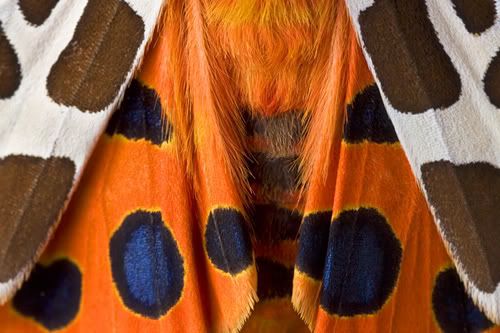 Garden tiger moth close-up by Paul Keene
This picture of a garden tiger moth (Arctia caja) was taken in Amersham, Buckinghamshire. The caterpillars of this moth feed on nettles, so if you want these moths to be a feature in your garden, then keep a rough, uncultivated patch
(via Look at This)
Garden tiger moth close-up by Paul Keene
This picture of a garden tiger moth (Arctia caja) was taken in Amersham, Buckinghamshire. The caterpillars of this moth feed on nettles, so if you want these moths to be a feature in your garden, then keep a rough, uncultivated patch
(via Look at This)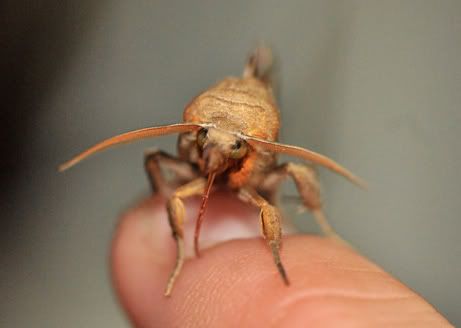 Scientists have found a previously unknown population of vampire moths that may have evolved from a fruit-eating species.
Only slight variations in wing patterns distinguish the Russian population from a widely distributed moth species, Calyptra thalictri, in Central and Southern Europe known to feed only on fruit.
Photograph by Sharon Hill
Source: National Geographic
Scientists have found a previously unknown population of vampire moths that may have evolved from a fruit-eating species.
Only slight variations in wing patterns distinguish the Russian population from a widely distributed moth species, Calyptra thalictri, in Central and Southern Europe known to feed only on fruit.
Photograph by Sharon Hill
Source: National Geographic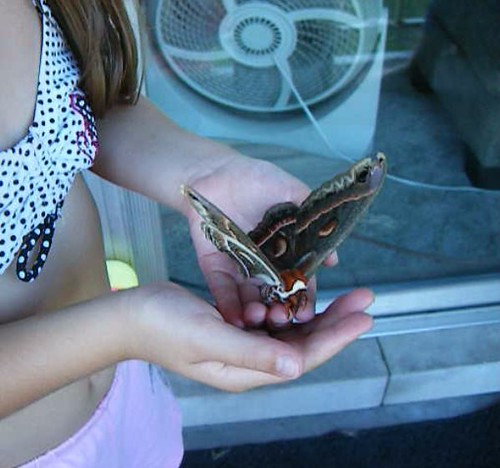 My friend Jake caught this monster moth in Crestwood, Illinois, in August, 2008. His daughter, age 8, is holding it. This has got to be the most ginourmous insect we've ever seen!
Does anyone know what this is?
Here's another look ...
My friend Jake caught this monster moth in Crestwood, Illinois, in August, 2008. His daughter, age 8, is holding it. This has got to be the most ginourmous insect we've ever seen!
Does anyone know what this is?
Here's another look ...
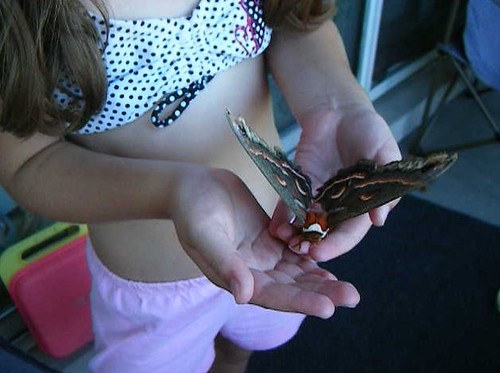 Yes, yes, we let it go after pictures were taken.
Photos: Julie Corsi
Yes, yes, we let it go after pictures were taken.
Photos: Julie Corsi