Saturday, March 21, 2009


Monday, February 16, 2009
It IS a mana"tee", you know
A manatee stuck in a pond at a private golf club in North Palm Beach was rescued today, the Florida Fish and Wildlife Conservation Commission reported.
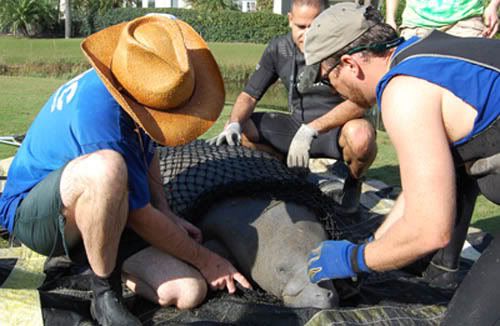 The 500-pound, six-foot long male accessed the pond by traveling through a culvert system and was in the pond for a day before it was rescued. The mammal showed signs of cold-stress and appeared thin, said FWC spokeswoman Gabriella Ferraro, in a press release.
The manatee has been taken to Miami Seaquarium's manatee rehabilitation facility for a check-up.
Source
The 500-pound, six-foot long male accessed the pond by traveling through a culvert system and was in the pond for a day before it was rescued. The mammal showed signs of cold-stress and appeared thin, said FWC spokeswoman Gabriella Ferraro, in a press release.
The manatee has been taken to Miami Seaquarium's manatee rehabilitation facility for a check-up.
Source
Monday, December 22, 2008
Cute or not? Baby Manatee
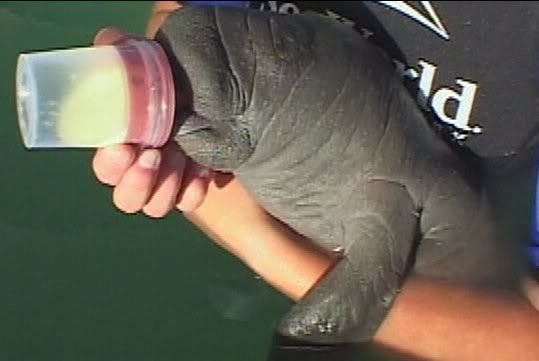 In 2008, SeaWorld, Orlando, has rehabilitated and released six manatees back into the wild.
Tuesday, January 15, 2008
All about manatees
Manatees (family Trichechidae, genus Trichechus) are large, aquatic marine mammals sometimes known as sea cows. The largest population of manatees is found in Florida, where there are over 3,000 individuals. The florida manatee, Florida’s state marine mammal, is a large aquatic relative of the elephant. They are grayish brown in color and have thick, wrinkled skin on which there is often a growth of algae. Well known for their gentle, slow-moving nature, manatees have also been known to body surf or barrel roll when playing. They normally rest and feed often. Manatees communicate by squealing under water to demonstrate fear, stress or excitement. Manatees are capable of understanding discrimination tasks, and show signs of complex associated learning and advanced long term memory. Manatees eat aquatic plants and can consume 10-15% of their body weight daily in vegetation. They graze for food along water bottoms and on the surface. They may rest submerged at the bottom or just below the surface, coming up to breathe on the average of every three to five minutes. Sources: Save the Manatee Defenders of Wildlife
Tuesday, April 3, 2007
Red Tide Suspected in Manatee Deaths
State officials suspect red tide may have killed some of the 26 manatees found dead in the Fort Myers area over the past two weeks. Red tide is caused by a bloom of the alga Karenia brevis, which contains a powerful toxin that can kill fish and other marine life. When manatees come up for air, they inhale the toxin at the water's surface. They also eat seagrasses that can absorb the toxin. Forty manatees have died in the Lee County area since the beginning of 2006. Last year, 417 manatee deaths were recorded statewide, the worst year on record.
Thursday, February 22, 2007
Long-captive manatees returned to wild
 ORANGE CITY, Fla. -- Two manatees that had been at an Ohio zoo were released into the wild on Tuesday at Blue Spring State Park in Volusia County.
Gene, who weighs about 1,900 pounds, had been in captivity for 30 years. When he was 2, he was hit by a boat and cut by its propeller in Brevard County.
Gene's son, Dundee, who weighs about 1,300 pounds, was released with his father. Dundee acted a little childish when workers tried to turn him on his stomach. He showed off for the waiting pod in the water and the crowd was delighted.
Researchers hope that Gene and Dundee will thrive in the wild. They have installed global position system-like devices in the manatees to monitor their progress.
"We're monitering him to make sure he is adapting, and if he is not, then we can intervene. We also do routine health assessments," said Monica Ross, a Wildlife Trust research scientist.
It was a bittersweet parting for some in the crowd, including Marvin Darvey, who watched over Gene in the Ohio zoo for more than six years.
"I am glad that he can get out there and meet some girls and maybe make some babies because that's the whole object," said Darvey.
ORANGE CITY, Fla. -- Two manatees that had been at an Ohio zoo were released into the wild on Tuesday at Blue Spring State Park in Volusia County.
Gene, who weighs about 1,900 pounds, had been in captivity for 30 years. When he was 2, he was hit by a boat and cut by its propeller in Brevard County.
Gene's son, Dundee, who weighs about 1,300 pounds, was released with his father. Dundee acted a little childish when workers tried to turn him on his stomach. He showed off for the waiting pod in the water and the crowd was delighted.
Researchers hope that Gene and Dundee will thrive in the wild. They have installed global position system-like devices in the manatees to monitor their progress.
"We're monitering him to make sure he is adapting, and if he is not, then we can intervene. We also do routine health assessments," said Monica Ross, a Wildlife Trust research scientist.
It was a bittersweet parting for some in the crowd, including Marvin Darvey, who watched over Gene in the Ohio zoo for more than six years.
"I am glad that he can get out there and meet some girls and maybe make some babies because that's the whole object," said Darvey.