It's an Armadillo Lizard.
Source

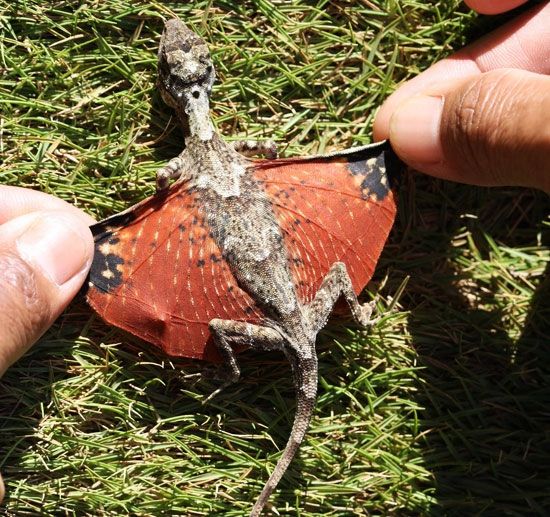
In Buton, Indonesia, there lives an insanely cool species of gliding lizard which looks like a miniature dragon.
 A vibrant green tree-dwelling lizard has surprised scientists with its mental prowess by succeeding in a problem-solving test.
The tropical lizard Anolis evermanni was able to associate the colour of a disc with a food reward - flipping over the correct disc to reveal a worm secreted underneath.
Read More - BBC Nature
 An Indonesian zoo is welcoming the arrival of 32 newborn Komodo dragons.
A zoo spokesman said the endangered lizards, believed to number less than 4,000 in the wild, all hatched in the last two weeks and 14 eggs are still under observation.
He calls it the Komodo's most successful breeding year ever at the zoo.
The giant reptiles first arrived in the early 1980s, but the new births brought their total from 34 to 66.
The Komodo dragon can grow up to 10 feet long and weigh as much as 150 pounds. They have a bite that can be deadly and can only be found in the wild on the eastern Indonesian islands of Komodo, Padar and Rinca.
Source
Photo credit: Christopher Furlong/Getty Images
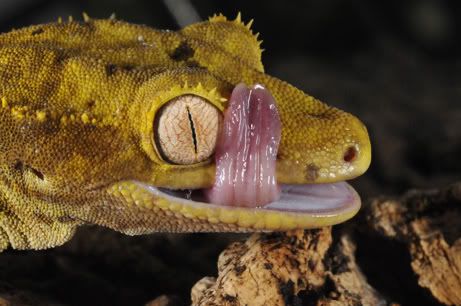 Lacking eyelids and true eyelashes, a New Caledonian crested gecko licks its eyeballs to keep them moist.
—Photograph by Julie Larsen Maher/WCS
Henry the Tuatara, regarded as the last of the dinosaurs, will become a father for the first time in 40 years at the ripe old age of 111.
 The indigenous New Zealand reptile - who is regarded as one of the last living descendants of the dinosaurs - has mated with Mildred, a youngster aged between 70 and 80.
The pair produced 12 eggs in mid-July after mating earlier this year at the Southland Museum on New Zealand's South Island, Tuatara curator Lindsay Hazley said.
Tuatara are the lizard-like last descendants of a species of reptile that walked the earth with the dinosaurs 225 million years ago, zoologists say.
Henry has lived at the Southland Museum's special enclosure for Tuatara since 1970 and had shown no interest in sex until he recently had a cancerous growth removed from his genitals.
He is now enjoying the company of three females and might breed again next March, Hazley said.
"With these guys, foreplay might take years. One has to be patient," he said.
Source: Daily Mail
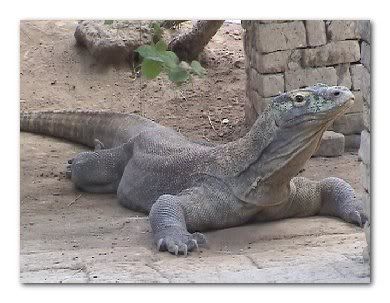 Komodo dragons may have a wimpy bite for their size, but somehow the giant lizards manage to take down prey as large as water buffalos.
A new study reveals that a few dozen razor-sharp teeth combined with beefy neck muscles make up for the reptile's dainty chomp.
The Komodo displays a unique hold-and-pull feeding technique. The lizard nabs prey with 60 perilous teeth, although its bite is weak. To make up for the lack of biting power, strong throat muscles drag the meal through the razor-sharp jowls and into the stomach.
Once a Komodo dragon maims its prey, which can weigh nearly as much as the lizard, it is swallowed whole and later regurgitated in a foul-smelling pellet of hair, bone and other indigestible remains. The lizards are also known for their infectious bites and parthenogenesis, or the ability to reproduce without mating.
Source: Yahoo News
 A Kernersville NC couple running a reptile business out of their home got a unique surprise when they discovered one of their new hatchlings had not one, but two heads.
There are only a few recorded cases of two-headed bearded dragons, also knows as agamid lizards, on record.
Source: WXII12.com
The Ouroboros is an ancient symbol depicting a serpent or dragon swallowing its own tail and forming a circle. It is one of the oldest mystical symbols in the world. The serpent or dragon appears in Aztec, Middle East, and Native American mythologies, among others. (from Wikipedia) xenmate at a near life experience has discovered the REAL ouroboros: This is an Armadillo Lizard, which, if frightened, will grab its tail in its mouth and roll into a ball.
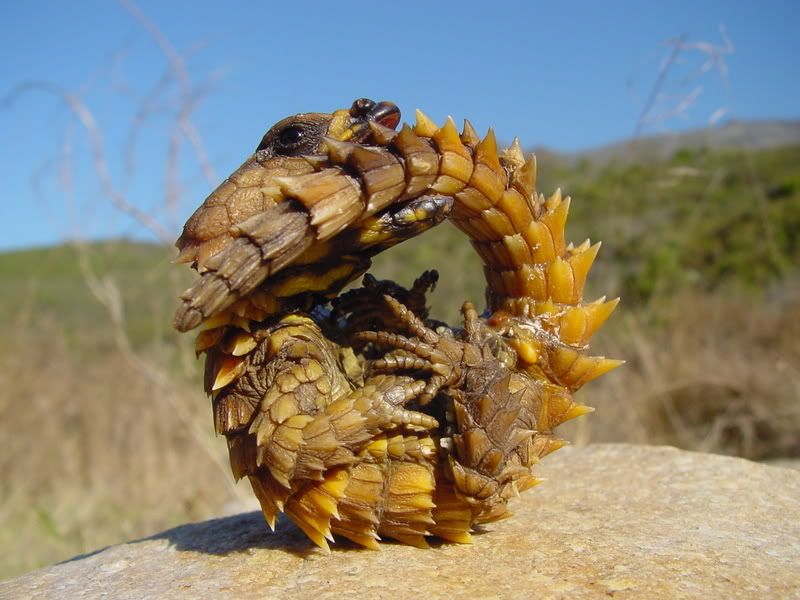 Photo: Cindy Shuttleworth
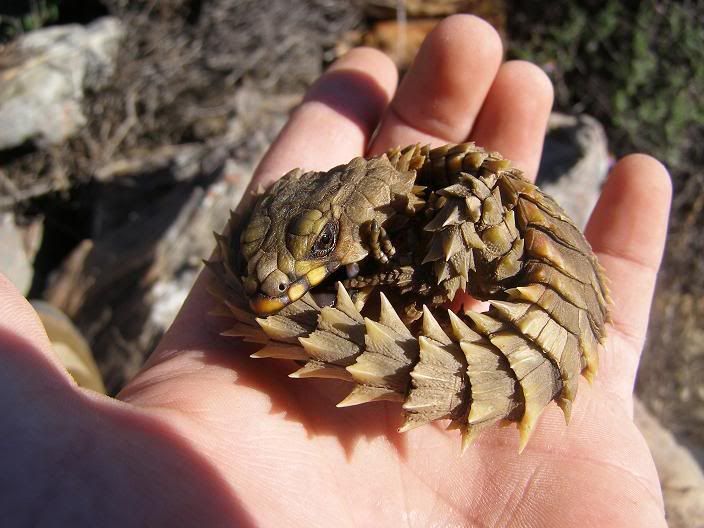 Photo: Morelia Hunter
 It may look like a snake and live like a snake. But a tiny reptile found recently in India is something else entirely, an Indian zoologist announced today.
The 7-inch (18-centimeter) creature is not a serpent at all, but actually a completely new species of limbless lizard, said Sushil Kumar Dutta of North Orissa University.
"The lizard is new to science and is an important discovery. It is not found anywhere else in the world," Dutta told the Associated Press.
"It prefers to live in a cool retreat, soft soil, and below stones," he added.
Though limbless lizards are rare, a number of such species have been found throughout the world, including elsewhere in India.
 An ancient arboreal lizard coasted through the air using a winglike membrane stretched across elongated ribs, a new fossil reveals.
Dubbed Xianglong zhaoi, the gliding lizard lived during the Early Cretaceous period, about 150 million years ago. The specimen, detailed Monday in the Proceedings of the National Academy of Sciences, is about 6 inches (15.5 centimeters) long, and its immature features suggest it died at a young age.
The fossil, described by Xing Xu of Shenyang Normal University in China and his colleagues, was discovered in northeastern China's Liaoning Province, a site that has yielded a treasure trove of feathered dinosaurs and early bird remains in recent years.