Source
A male leopard with a strawberry-colored coat has been spotted in South Africa's Madikwe Game Reserve, conservationists announced this week.
Tourists in the reserve had occasionally seen the unusual animal. But it wasn't until recently that photographer and safari guide Deon De Villiers sent a photograph to experts at Panthera, a U.S.-based wild cat-conservation group, to ask them about the leopard's odd coloration.
It is suspected that the pale leopard has erythrism, a little-understood genetic condition that's thought to cause either an overproduction of red pigments or an underproduction of dark pigments.
Source
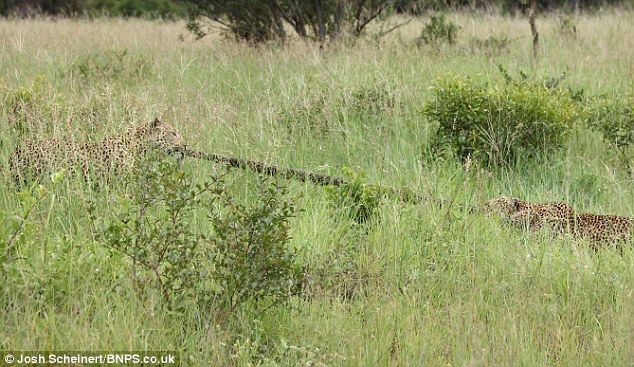
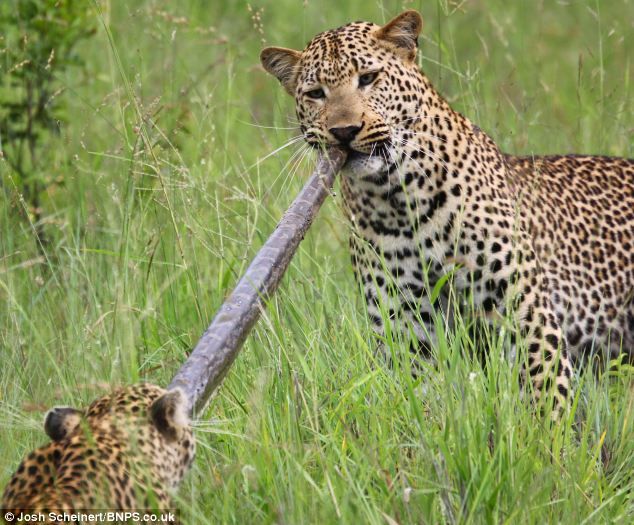 A six-and-a-half-ft long African rock python became the unwilling 'rope' in the game, after being captured by a female leopard in the long grass.
But as she dragged it, still wriggling, along behind her, she was ambushed by her over-zealous son who wanted to land the kill for himself.
The young male snatched the end of the enormous snake in his powerful jaws, and tried to tug it away from his mother.
The two big cats fought ferociously over their prey for half an hour, in front of stunned guests at the MalaMala game reserve, South Africa.
A six-and-a-half-ft long African rock python became the unwilling 'rope' in the game, after being captured by a female leopard in the long grass.
But as she dragged it, still wriggling, along behind her, she was ambushed by her over-zealous son who wanted to land the kill for himself.
The young male snatched the end of the enormous snake in his powerful jaws, and tried to tug it away from his mother.
The two big cats fought ferociously over their prey for half an hour, in front of stunned guests at the MalaMala game reserve, South Africa.
 Source
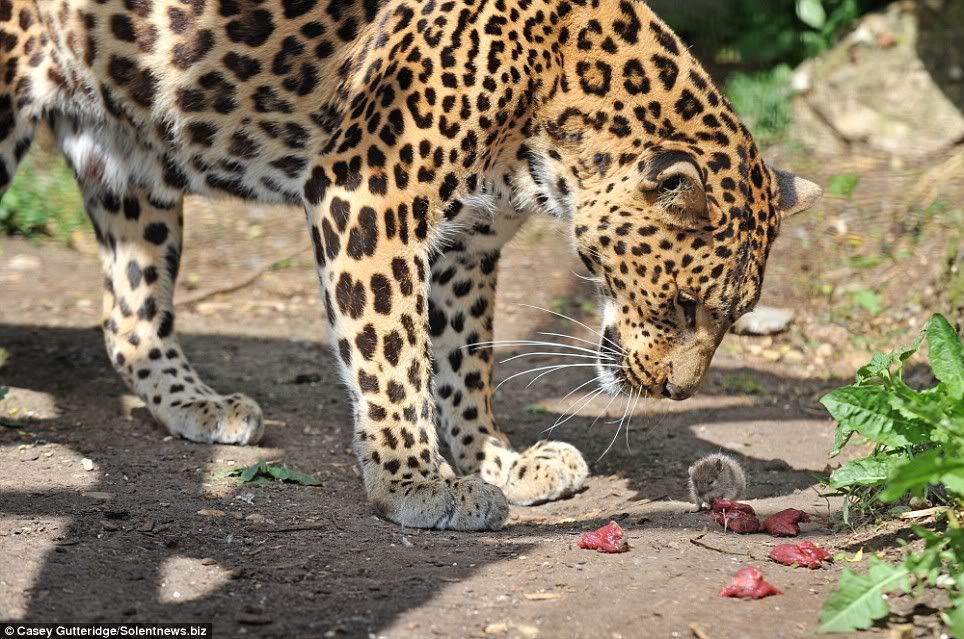
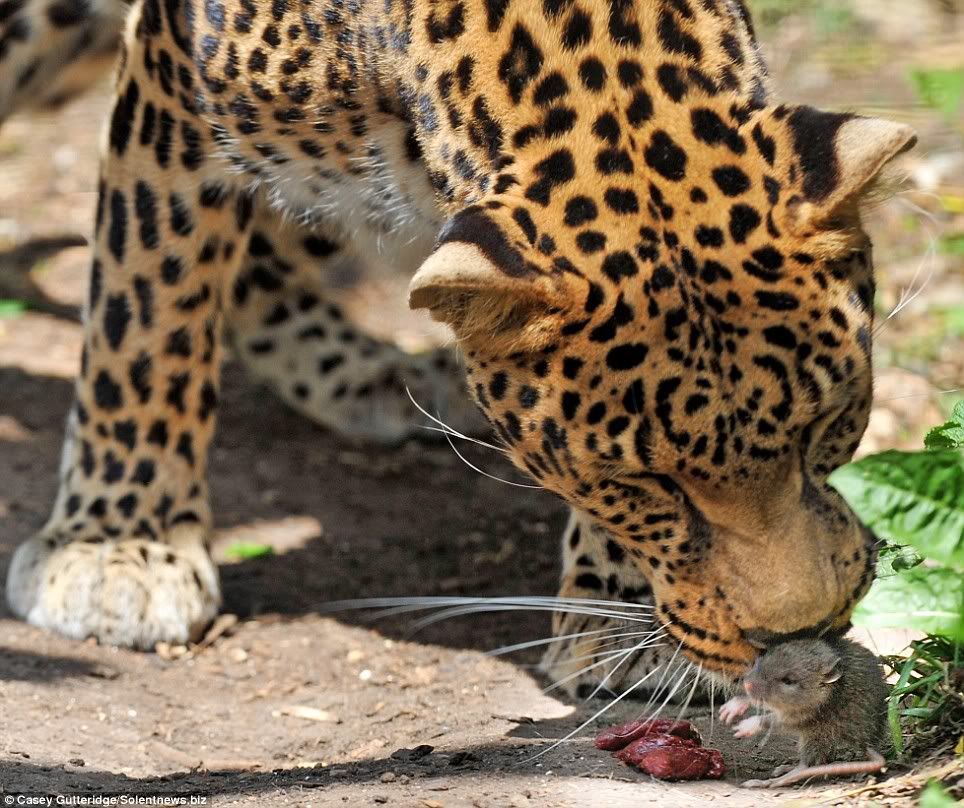
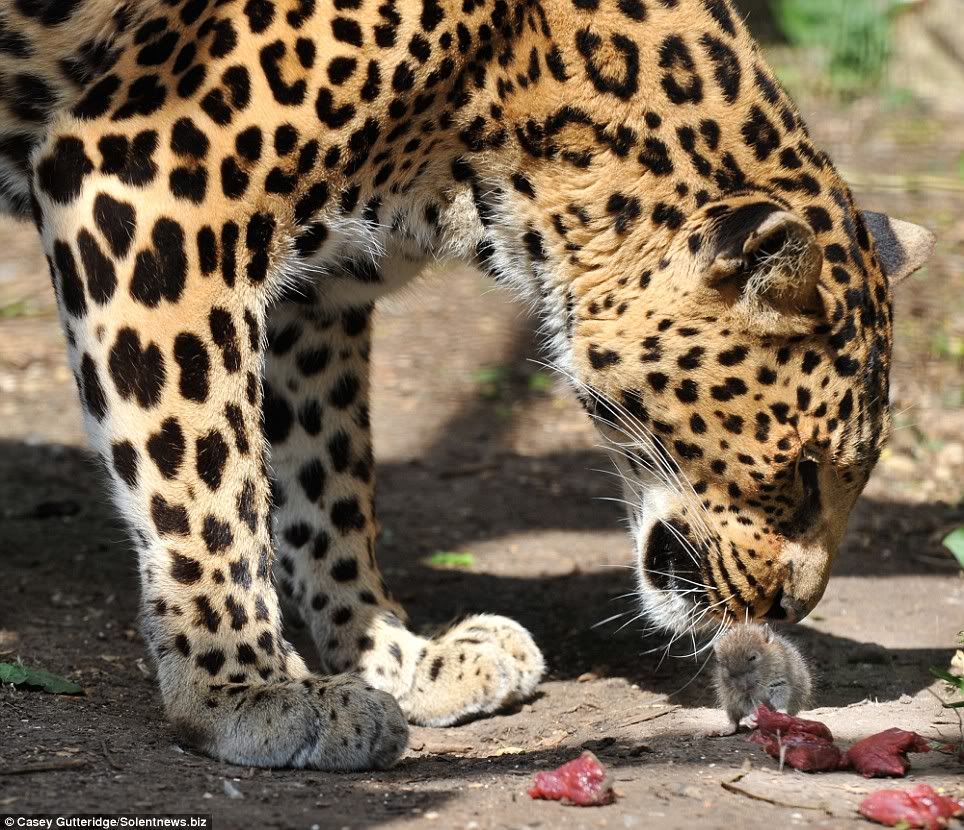
Even the imposing presence of an adult leopard at feeding time is not enough to get between plucky young Rattus Norvegicus (better known as the brown rat) and a free meal.
This extraordinary series of images were captured by photography student Casey Gutteridge, as he trained his camera on the leopard for a course project.
 Source
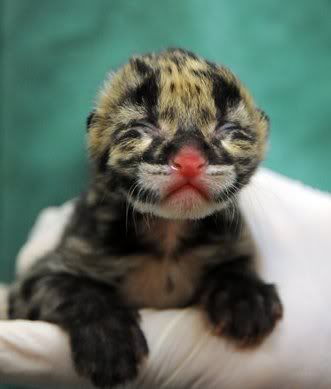
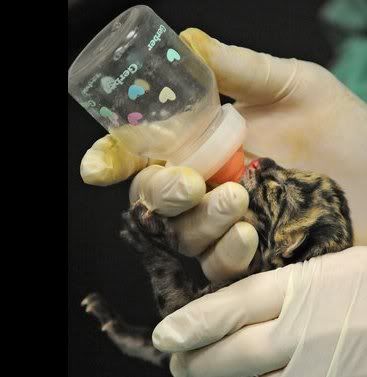
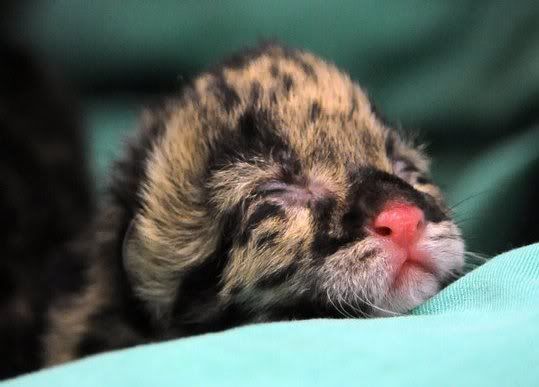
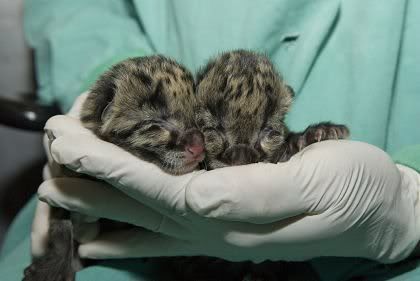 In the end, Hannibal did not administer the fatal bite to his mate's neck. And Jao Chu did not immediately kill their offspring, as is often the case.
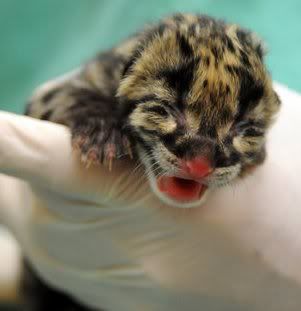
And so, early yesterday, despite murderous tendencies in the captive species, two newborn clouded leopard cubs were found alive, well and squealing at the National Zoo's Conservation and Research Center in Front Royal, Va.
They were taken immediately from their gorgeous mother before she could do them harm, or do them in, placed in an incubator set at 88 degrees and fed salt water from baby bottles. Born with dappled, reptile-pattern fur, they were the first such births at the zoo in 16 years.
Their births were a coup, and the end of a complex reproduction saga involving an exotic, endangered and beautiful species of animal that experts call the ghost cat.
It was also a genetic home run: The zoo said the cubs' genes, which come from outside the captive population, make them among the most valuable clouded leopards in North America.
Source
Photo credit: Tracy A Woodward-The Washington Post
In the end, Hannibal did not administer the fatal bite to his mate's neck. And Jao Chu did not immediately kill their offspring, as is often the case.
And so, early yesterday, despite murderous tendencies in the captive species, two newborn clouded leopard cubs were found alive, well and squealing at the National Zoo's Conservation and Research Center in Front Royal, Va.
They were taken immediately from their gorgeous mother before she could do them harm, or do them in, placed in an incubator set at 88 degrees and fed salt water from baby bottles. Born with dappled, reptile-pattern fur, they were the first such births at the zoo in 16 years.
Their births were a coup, and the end of a complex reproduction saga involving an exotic, endangered and beautiful species of animal that experts call the ghost cat.
It was also a genetic home run: The zoo said the cubs' genes, which come from outside the captive population, make them among the most valuable clouded leopards in North America.
Source
Photo credit: Tracy A Woodward-The Washington Post
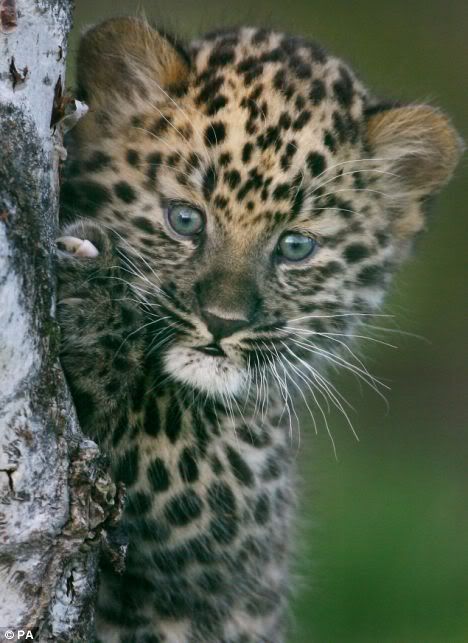 8-week old Amur leopard at the Wildlife Heritage Foundation (WHF), a conservation charity based in Smarden, Kent
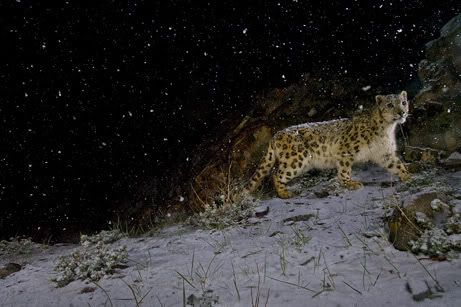 Stalking India's Hemis National Park, a snow leopard lives up to its name in U.S. photographer Steve Winter's award-winning National Geographic magazine image.
On October 30, 2008, "Snowstorm Leopard" was named best overall photo in the 2008 Wildlife Photographer of the Year competition, which is organized by the Natural History of London and BBC Wildlife Magazine.
As few as 3,500 snow leopards remain in the wild.
(See more snow leopard photos by Winter.)
Source: National Geographic
Stalking India's Hemis National Park, a snow leopard lives up to its name in U.S. photographer Steve Winter's award-winning National Geographic magazine image.
On October 30, 2008, "Snowstorm Leopard" was named best overall photo in the 2008 Wildlife Photographer of the Year competition, which is organized by the Natural History of London and BBC Wildlife Magazine.
As few as 3,500 snow leopards remain in the wild.
(See more snow leopard photos by Winter.)
Source: National Geographic
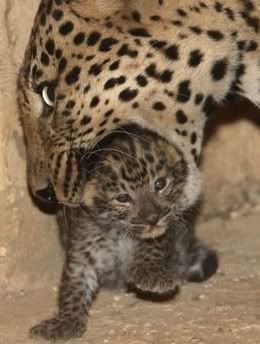 An African leopard carries its one-week-old cub inside its enclosure at Ghamadan zoo near Amman July 2, 2008.
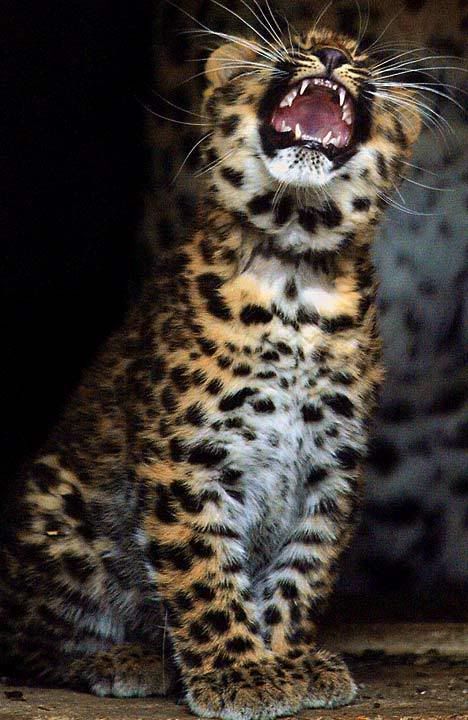 This fourteen-week-old baby Amur leopard already has a fearsome set of fangs. As a member of the world's rarest big cat species, she is bound to become the star attraction at Marwell Zoo in Hampshire.
But with the wild population said to be as little as 35, her real significance is to conservationists.
Only half a dozen Amurs left in their native habitat on Siberia's Pacific coast near the Korean border are thought to be females.
Source: the Daily Mail
This fourteen-week-old baby Amur leopard already has a fearsome set of fangs. As a member of the world's rarest big cat species, she is bound to become the star attraction at Marwell Zoo in Hampshire.
But with the wild population said to be as little as 35, her real significance is to conservationists.
Only half a dozen Amurs left in their native habitat on Siberia's Pacific coast near the Korean border are thought to be females.
Source: the Daily Mail
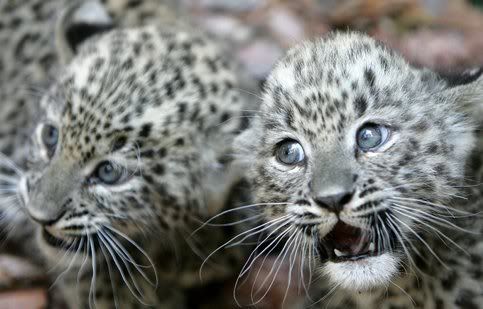 Persian leopard triplets born in June were presented Tuesday at the Budapest Zoo. The cubs—a male and two females—were born at the zoo on June 19 and are doing well, said zoo spokesman Zoltan Hanga.
The Persian leopard is the largest of the leopard subspecies and is native to Western Asian countries such as Iraq, Afghanistan and Armenia.
The leopard is endangered, however, with less than 2,000 thought to be living in the wild. An additional 74 leopards live in zoos.
The cubs born in Hungary—sisters Bella and Bara and brother Bahar—are part of a breeding program of the European Association of Zoos and Aquaria.
Persian leopard triplets born in June were presented Tuesday at the Budapest Zoo. The cubs—a male and two females—were born at the zoo on June 19 and are doing well, said zoo spokesman Zoltan Hanga.
The Persian leopard is the largest of the leopard subspecies and is native to Western Asian countries such as Iraq, Afghanistan and Armenia.
The leopard is endangered, however, with less than 2,000 thought to be living in the wild. An additional 74 leopards live in zoos.
The cubs born in Hungary—sisters Bella and Bara and brother Bahar—are part of a breeding program of the European Association of Zoos and Aquaria.
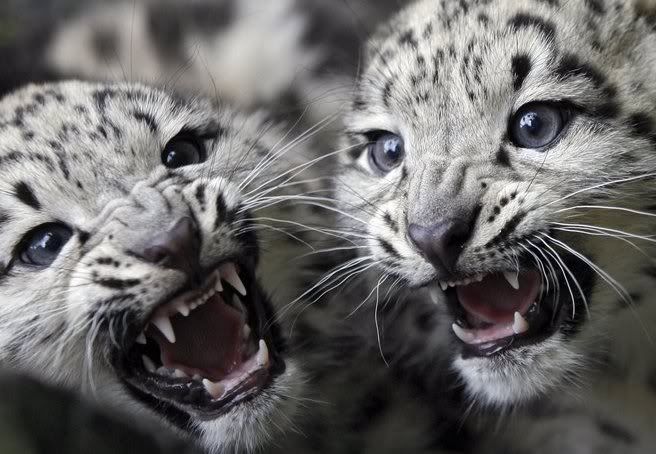 Ten-week old snow leopards Lanak, left, and Askai hiss to photographers during their first appearance in the Berlin Zoo in Germany.
(Photo credit: Markus Schreiber - AP)
Ten-week old snow leopards Lanak, left, and Askai hiss to photographers during their first appearance in the Berlin Zoo in Germany.
(Photo credit: Markus Schreiber - AP)
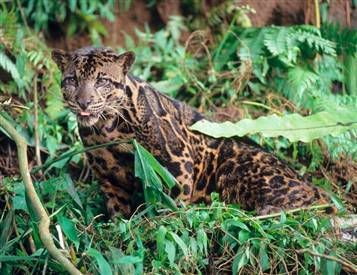 New research reveals the existence of two completely separate species of clouded leopards. In a study comparing differences in clouded leopard coat patterns and coloration throughout the cat's range, researchers concluded that individuals found on the islands of Borneo and Sumatra are markedly different from animals found on the Southeast Asian mainland. These observations have been supported by genetic testing that determined the two populations of clouded leopards are so distinct as to warrant classifying them as different species. Researchers estimate that the two species diverged approximately 1.5 million years ago due to geographical isolation.
(Photo credit: Photo: Alain Compost/WWF-Canon)
New research reveals the existence of two completely separate species of clouded leopards. In a study comparing differences in clouded leopard coat patterns and coloration throughout the cat's range, researchers concluded that individuals found on the islands of Borneo and Sumatra are markedly different from animals found on the Southeast Asian mainland. These observations have been supported by genetic testing that determined the two populations of clouded leopards are so distinct as to warrant classifying them as different species. Researchers estimate that the two species diverged approximately 1.5 million years ago due to geographical isolation.
(Photo credit: Photo: Alain Compost/WWF-Canon)
 JERUSALEM (AP) -- A man clad only in underwear and a T-shirt wrestled a wild leopard to the floor and pinned it for 20 minutes after the cat leapt through a window of his home and hopped into bed with his sleeping family.
"This kind of thing doesn't happen every day," said 49-year-old Arthur Du Mosch, a nature guide. "I don't know why I did it. I wasn't thinking, I just acted."
Raviv Shapira, who heads the southern district of the Israel Nature and Parks Protection Authority, said a half dozen leopards have been spotted recently near Du Mosch's small community of Kibbutz Sde Boker in the Negev desert in southern Israel, although they rarely threaten humans.
JERUSALEM (AP) -- A man clad only in underwear and a T-shirt wrestled a wild leopard to the floor and pinned it for 20 minutes after the cat leapt through a window of his home and hopped into bed with his sleeping family.
"This kind of thing doesn't happen every day," said 49-year-old Arthur Du Mosch, a nature guide. "I don't know why I did it. I wasn't thinking, I just acted."
Raviv Shapira, who heads the southern district of the Israel Nature and Parks Protection Authority, said a half dozen leopards have been spotted recently near Du Mosch's small community of Kibbutz Sde Boker in the Negev desert in southern Israel, although they rarely threaten humans.
 Hunters in Russia's Far East have shot and killed one of the last seven surviving female Amur leopards living in the wild, WWF said on Monday, driving the species even closer to extinction.
Last week environmentalists said there were only between 25 and 34 Amur leopards -- described as one of the most graceful cats in the world -- still living in the wild. (Full story)
"Leopard murder can only be provoked by cowardice or stupidity, in this case most likely by both," Pavel Fomenko, WWF's biodiversity coordinator in Russia's Far East said in a statement.
A hunter shot the leopard through the tail bone. It tumbled over and was then beaten over the head with a heavy object, WWF said. Amur leopards have not been know to attack humans.
Hunters in Russia's Far East have shot and killed one of the last seven surviving female Amur leopards living in the wild, WWF said on Monday, driving the species even closer to extinction.
Last week environmentalists said there were only between 25 and 34 Amur leopards -- described as one of the most graceful cats in the world -- still living in the wild. (Full story)
"Leopard murder can only be provoked by cowardice or stupidity, in this case most likely by both," Pavel Fomenko, WWF's biodiversity coordinator in Russia's Far East said in a statement.
A hunter shot the leopard through the tail bone. It tumbled over and was then beaten over the head with a heavy object, WWF said. Amur leopards have not been know to attack humans.
 The green group WWF Wednesday urged the Russian government to set up a national reserve in the country's far-east to protect the endangered Amur leopard.
According to the last survey carried out by Russian and American scientists, between 24 and 35 leopards remain in their natural habitat spread over three reserves located near the Chinese border and along the Amur river.
"In China there are only a handful of Amur leopards left," he said. "All the body parts of the female are used for making medicines -- even whiskers and teeth."
The green group WWF Wednesday urged the Russian government to set up a national reserve in the country's far-east to protect the endangered Amur leopard.
According to the last survey carried out by Russian and American scientists, between 24 and 35 leopards remain in their natural habitat spread over three reserves located near the Chinese border and along the Amur river.
"In China there are only a handful of Amur leopards left," he said. "All the body parts of the female are used for making medicines -- even whiskers and teeth."