Sunday, June 24, 2012


Monday, March 26, 2012
Painted chimps
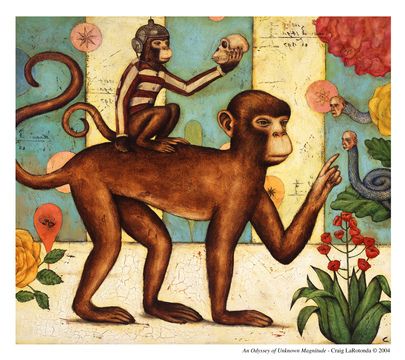
We found Craig and his wonderful portraits at Thumbtack Press, a handpicked collection of open-edition prints by over 100 top lowbrow, illustration, and character artists from around the world.
Take a look - it's like visiting an art gallery.
Saturday, March 10, 2012
Sunday, February 19, 2012
Friday, August 5, 2011

Monday, January 31, 2011
Chimpanzees mourn their dead just like humans
According to a report by scientists from the respected Max Planck Institute for Psycholinguistics, chimpanzees appear to mourn their dead infants just like humans.
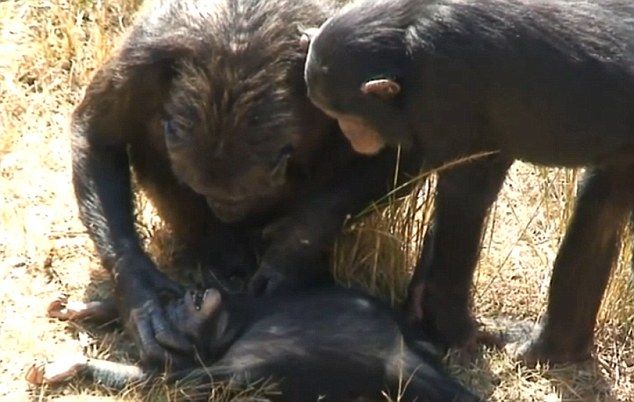
The scientists have filmed how one chimpanzee mother, whose 16-month-old infant died, apparently begins the grieving process. The ape continues to carry the body of her baby for more than 24 hours before tenderly laying it on the ground. Then from a short distance she watches over her child.
Periodically she returns to the body and touches the face and neck with her fingers to establish it is dead. She then takes the body to other chimpanzees in the troop to get a second opinion.
 Source
Friday, June 5, 2009
Wednesday, May 27, 2009
Wednesday, March 18, 2009
Friday, March 13, 2009
Take some time out to read this:
 Excellent Op-Ed piece in The New York Times, "Something Wild," by Charles Siebert examines human interaction with chimpanzees in light of the horrific attack in Stamford, Conn., last month — in which a pet chimp named Travis mauled a woman, robbing her of her hands, eyesight and much of her face, and possibly causing brain damage.
Siebert theorizes that domesticated chimps are prone to psychological problems, "Wild chimps “recruited” by poachers for entertainment watch as their mothers are gunned down — the only way a chimp mother would ever relinquish a child.
Chimps born in captivity are spared that experience, but they suffer the same premature separation from their mothers, isolation from their normal social groups and often mistreatment from trainers and keepers, all traumatic events that have been shown to cause deep psychological scarring and, as in human beings, can lead an animal to overreact to the slightest stimuli."
He recounts the heartbreaking tale of Lucy, raised from infancy to age 10 as if she were a human child. When she reached sexual maturity and became difficult to handle, her "parents" sent her to a place that was the complete opposite of what she knew, a refuge that reintroduces captive chimps into the wild. Lucy refused to socialize with the other chimps, to climb trees, forage for food, make nests. She took to waiting beneath trees for the others’ crumbs to fall. Eventually, Lucy’s skeleton was found near the shores of the island refuge.
Read more
Excellent Op-Ed piece in The New York Times, "Something Wild," by Charles Siebert examines human interaction with chimpanzees in light of the horrific attack in Stamford, Conn., last month — in which a pet chimp named Travis mauled a woman, robbing her of her hands, eyesight and much of her face, and possibly causing brain damage.
Siebert theorizes that domesticated chimps are prone to psychological problems, "Wild chimps “recruited” by poachers for entertainment watch as their mothers are gunned down — the only way a chimp mother would ever relinquish a child.
Chimps born in captivity are spared that experience, but they suffer the same premature separation from their mothers, isolation from their normal social groups and often mistreatment from trainers and keepers, all traumatic events that have been shown to cause deep psychological scarring and, as in human beings, can lead an animal to overreact to the slightest stimuli."
He recounts the heartbreaking tale of Lucy, raised from infancy to age 10 as if she were a human child. When she reached sexual maturity and became difficult to handle, her "parents" sent her to a place that was the complete opposite of what she knew, a refuge that reintroduces captive chimps into the wild. Lucy refused to socialize with the other chimps, to climb trees, forage for food, make nests. She took to waiting beneath trees for the others’ crumbs to fall. Eventually, Lucy’s skeleton was found near the shores of the island refuge.
Read more
Tuesday, March 10, 2009

Monday, February 16, 2009
Another inappropriate pet goes bad
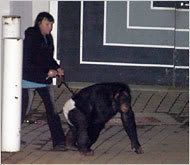 A 200-pound chimpanzee kept as a pet attacked and seriously injured a woman visiting a Stamford, Conn., home Monday, the police said.
The chimpanzee, named Travis, who had appeared in television commercials, was shot and killed by an officer when he charged the police and cornered that officer in his cruiser, the police said.
The injured woman was hospitalized late Monday in very serious condition at Stamford Hospital. Her identity was not released.
Stamford police Capt. Richard Conklin said the woman was getting out of her car in front of her friend’s house when Travis attacked for no apparent reason.
Sandra Herold, the owner of the 15-year-old chimpanzee, wrestled with the animal as it mauled her friend, then ran inside to call 911.
“She retrieved a large butcher knife and stabbed her longtime pet numerous times in an effort to save her friend, who was really being brutally attacked,” Captain Conklin said.
More of this sad story.
Photo: Associated Press Photo of Travis in 2003
Source
A 200-pound chimpanzee kept as a pet attacked and seriously injured a woman visiting a Stamford, Conn., home Monday, the police said.
The chimpanzee, named Travis, who had appeared in television commercials, was shot and killed by an officer when he charged the police and cornered that officer in his cruiser, the police said.
The injured woman was hospitalized late Monday in very serious condition at Stamford Hospital. Her identity was not released.
Stamford police Capt. Richard Conklin said the woman was getting out of her car in front of her friend’s house when Travis attacked for no apparent reason.
Sandra Herold, the owner of the 15-year-old chimpanzee, wrestled with the animal as it mauled her friend, then ran inside to call 911.
“She retrieved a large butcher knife and stabbed her longtime pet numerous times in an effort to save her friend, who was really being brutally attacked,” Captain Conklin said.
More of this sad story.
Photo: Associated Press Photo of Travis in 2003
Source
Monday, February 9, 2009
Baby Chimps Given Human Love Are Smarter
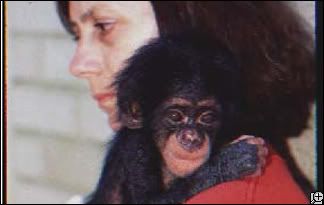 Orphaned infant chimpanzees that received attentive, nurturing care from human surrogate mothers were found to be more intellectually advanced than the average human baby when both groups were compared at the age of nine months, according to a new study published in the latest issue of Developmental Psychobiology.
When the chimps were nine months old, they took an IQ test normally used to evaluate human infant development. The chimps who had received responsive care aced the test, even surpassing the scores of average human infants tested at the same age.
Source
Orphaned infant chimpanzees that received attentive, nurturing care from human surrogate mothers were found to be more intellectually advanced than the average human baby when both groups were compared at the age of nine months, according to a new study published in the latest issue of Developmental Psychobiology.
When the chimps were nine months old, they took an IQ test normally used to evaluate human infant development. The chimps who had received responsive care aced the test, even surpassing the scores of average human infants tested at the same age.
Source
Friday, November 14, 2008
Tuesday, May 13, 2008
Care for Apes
What happens to performing primates once they're past their prime? The lucky ones end up in facilities like the Center for Great Apes in Wauchula, FL. Brenda Scott Royce, in the Huffington Post, writes,
" Apes in showbiz have a short shelf life. The average performing chimp begins his career around age 2. By 7 or 8, when he's no longer the tractable trainee he once was, he's put out to pasture. Owners tend to not want to keep apes that have outlived their earning potential, and since apes can live into their 50s, that means they'll require decades of care after their careers end. And that care is expensive -- roughly $10,000 a year for a single ape. And while typically everyone involved with a film -- from cast and crew to producers, studios, distributors, investors and exhibitors -- makes money, nothing is put aside for the animals' future. "The primary purpose of the Center for Great Apes is to provide a permanent sanctuary in a safe and enriching environment for orangutans and chimpanzees in need of long-term life care … specifically those who have been used in entertainment, kept as pets by private owners, or served as research subjects. Currently, the Center houses forty-three apes, fourteen orangutans and twenty-nine chimpanzees, ranging in age from one to forty-six years. These great apes live in enriching environments and habitats, provided with proper nutrition and companionship and with their own species. They live in large 34-foot tall outdoor habitats with lots of climbing apparatus, swings, and enrichment toys. They sleep in attached heated nighthouses strong enough to withstand Florida hurricanes. The sanctuary is located in South Central Florida on 100 wooded acres surrounded by orange groves.
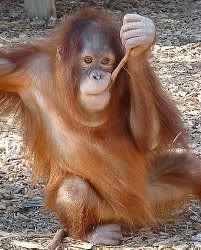 Pebbles is one of the Center for Great Apes current residents. She arrived at the Center in December 2004 from a California trainer compound where she was worked as an infant in the entertainment business. She still had a few years of working ability ahead of her, but her owner decided to stop working great apes in shows and commercials.
Pebbles loves to swing on vines in her enclosure, play in tubs of water, and wrestle with her orangutan roommates. One of her favorite enrichment activities is painting. Not only will she paint on paper or canvas given to her, Pebbles also enjoys covering herself with nontoxic paint!
via L.A. Unleashed
Pebbles is one of the Center for Great Apes current residents. She arrived at the Center in December 2004 from a California trainer compound where she was worked as an infant in the entertainment business. She still had a few years of working ability ahead of her, but her owner decided to stop working great apes in shows and commercials.
Pebbles loves to swing on vines in her enclosure, play in tubs of water, and wrestle with her orangutan roommates. One of her favorite enrichment activities is painting. Not only will she paint on paper or canvas given to her, Pebbles also enjoys covering herself with nontoxic paint!
via L.A. Unleashed
Sunday, February 24, 2008
The Naked Ape
 Cinder, the hairless chimpanzee, is a popular attraction at the St. Louis Zoo in Missouri.
Cinder was born with a full coat of hair on August 9, 1994, to mother Mollie, and father, Smoke. When she was about five months old, Cinder began losing some hair. She continued to lose her hair and in a definite pattern, first from her lower body and gradually extending up until after close to a year, Cinder was completely bald.
Afflicted with alopecia universalis. Cinder is otherwise a normal, healthy chimpanzee and, unlike humans, is not faced with the psychological and social challenges the disease presents.
(via)
Cinder, the hairless chimpanzee, is a popular attraction at the St. Louis Zoo in Missouri.
Cinder was born with a full coat of hair on August 9, 1994, to mother Mollie, and father, Smoke. When she was about five months old, Cinder began losing some hair. She continued to lose her hair and in a definite pattern, first from her lower body and gradually extending up until after close to a year, Cinder was completely bald.
Afflicted with alopecia universalis. Cinder is otherwise a normal, healthy chimpanzee and, unlike humans, is not faced with the psychological and social challenges the disease presents.
(via)
Thursday, January 31, 2008
Ham, the first chimpanzee astronaut
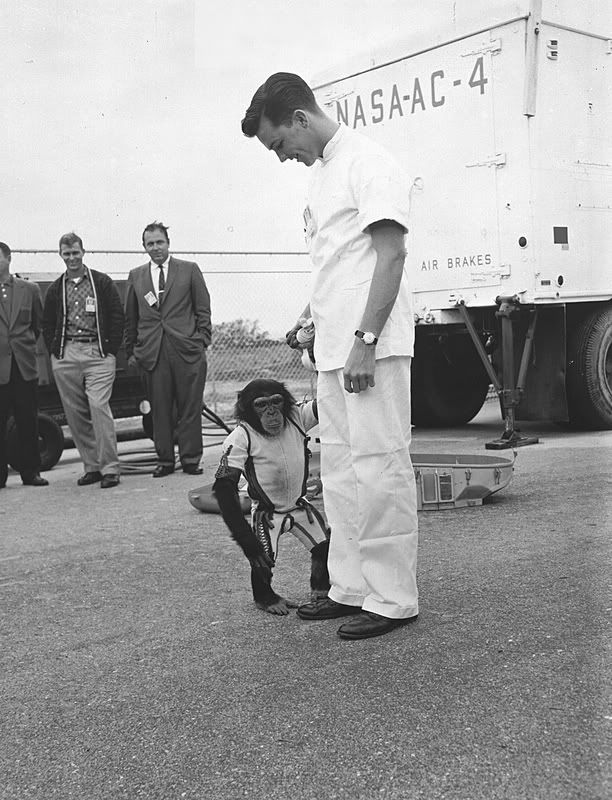 Ham, the first chimpanzee ever to ride into space is shown off by his animal trainer on January 31, 1961, at Cape Canaveral, Florida.
Ham was brought from the French Camaroons, West Africa, where he was born July 1957, to Holloman Air Force Base in New Mexico in 1959.
On January 31, 1961, Ham, whose name was an acronym for H olloman A ero M ed, became the first chimpanzee in space, aboard the Mercury Redstone rocket on a sub-orbital flight.
The spacecraft carrying Ham reached an altitude of 157 miles and a speed of 5857 mph. Ham performed well during his flight and splashed down in the Atlantic Ocean 60 miles from the recovery ship. He experienced a total of 6.6 minutes of weightlessness during a 16.5-minute flight.
Ham was placed on display at the Washington Zoo in 1963 where he lived alone until September 25, 1980. He then was moved to the North Carolina Zoological Park in Asheboro. Upon his death on January 17, 1983, Ham's body was preserved and loaned by the Smithsonian Institution to the International Space Hall of Fame in Alamogordo, New Mexico.
Source: NASA
Ham, the first chimpanzee ever to ride into space is shown off by his animal trainer on January 31, 1961, at Cape Canaveral, Florida.
Ham was brought from the French Camaroons, West Africa, where he was born July 1957, to Holloman Air Force Base in New Mexico in 1959.
On January 31, 1961, Ham, whose name was an acronym for H olloman A ero M ed, became the first chimpanzee in space, aboard the Mercury Redstone rocket on a sub-orbital flight.
The spacecraft carrying Ham reached an altitude of 157 miles and a speed of 5857 mph. Ham performed well during his flight and splashed down in the Atlantic Ocean 60 miles from the recovery ship. He experienced a total of 6.6 minutes of weightlessness during a 16.5-minute flight.
Ham was placed on display at the Washington Zoo in 1963 where he lived alone until September 25, 1980. He then was moved to the North Carolina Zoological Park in Asheboro. Upon his death on January 17, 1983, Ham's body was preserved and loaned by the Smithsonian Institution to the International Space Hall of Fame in Alamogordo, New Mexico.
Source: NASA
Saturday, January 26, 2008
Wednesday, January 16, 2008
Chimp not a person, Austrian court rules
Austria's Supreme Court ruled that a chimpanzee named Matthew Hiasl Pan cannot be declared a person. The shelter where Matthew has lived for 25 years is going bankrupt, threatening to leave him homeless. Matthew and another chimp at the shelter, Rosi, were captured as babies in Sierra Leone in 1982 and smuggled to Austria for use in pharmaceutical experiments. Customs officers intercepted the shipment and turned the chimps over to the shelter. Donors have offered to help support Matthew, but under Austrian law, only a person can receive personal gifts. Source: AP
Wednesday, November 7, 2007
What we learned from Washoe the chimp
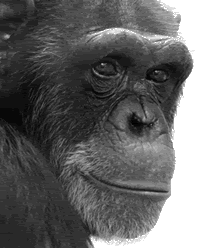 There aren't many people who lived through the 20th Century, including learned philosophers, scientists and thinkers, whose lives and work so forcefully altered the human intellectual landscape as did that of Washoe, a 42-year-old female chimpanzee who died October 30th in a research center in eastern Washington state.
Her life permanently changed the popular perception of animal intelligence, overturning long-held assumptions about differences between humans and other great apes, and presaging the genetic revolution that would reveal that humans and chimps biologically aren't separated by much.
Photo credit
There aren't many people who lived through the 20th Century, including learned philosophers, scientists and thinkers, whose lives and work so forcefully altered the human intellectual landscape as did that of Washoe, a 42-year-old female chimpanzee who died October 30th in a research center in eastern Washington state.
Her life permanently changed the popular perception of animal intelligence, overturning long-held assumptions about differences between humans and other great apes, and presaging the genetic revolution that would reveal that humans and chimps biologically aren't separated by much.
Photo credit