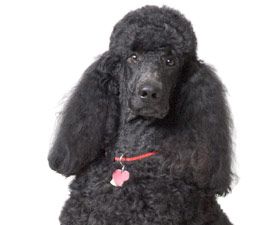
 The oldest dogs from France were small, lap-sized canines that lived up to 15,000 years ago, according to new research.
These poodle-sized dogs raise a lot of questions about the earliest domestication of dogs, due to their impressive age and the fact that most other prehistoric pooches were much larger.
"One or many domestication events could have occurred in France and, more generally, in the western part of Europe," Maud Pionnier-Capitan told Discovery News. She led the French project, described in a paper accepted for publication in the Journal of Archaeological Science.
In 2008, Mietje Germonpre, a paleontologist at the Royal Belgian Institute of Natural Sciences, and her team identified what they believe is the world's first known dog.
Found in a Belgian cave, the remains for this possible dog suggest that it lived around 32,000 years ago and resembled a Siberian husky. But it was about the size of a large shepherd dog.
Germonpre told Discovery News that it's unclear now whether these much smaller French dogs descended from the European Paleolithic stock of large dogs, were introduced from elsewhere, or resulted through selection for a smaller body size.
Read more . . .
The oldest dogs from France were small, lap-sized canines that lived up to 15,000 years ago, according to new research.
These poodle-sized dogs raise a lot of questions about the earliest domestication of dogs, due to their impressive age and the fact that most other prehistoric pooches were much larger.
"One or many domestication events could have occurred in France and, more generally, in the western part of Europe," Maud Pionnier-Capitan told Discovery News. She led the French project, described in a paper accepted for publication in the Journal of Archaeological Science.
In 2008, Mietje Germonpre, a paleontologist at the Royal Belgian Institute of Natural Sciences, and her team identified what they believe is the world's first known dog.
Found in a Belgian cave, the remains for this possible dog suggest that it lived around 32,000 years ago and resembled a Siberian husky. But it was about the size of a large shepherd dog.
Germonpre told Discovery News that it's unclear now whether these much smaller French dogs descended from the European Paleolithic stock of large dogs, were introduced from elsewhere, or resulted through selection for a smaller body size.
Read more . . .
Friday, April 8, 2011
World's oldest known dogs from France were poodle-sized


Tuesday, April 5, 2011
Native Americans & dogs - companions in past centuries
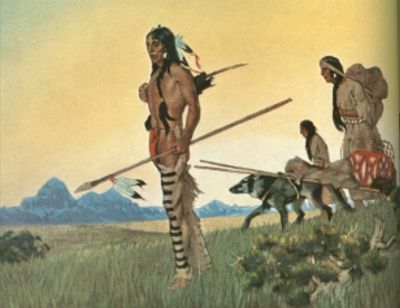 The close, personal bonds between humans and their dogs date back centuries in California, according to new archaeological research that illuminates the relationship between the state's Central Valley Indian tribes and their dogs.
The evidence: Central Valley Indians buried their dogs carefully and with ceremony. People and their dogs were often buried together, curled up side by side.
Paul Langenwalter, a professor of archaeology and anthropology at Biola University in La Mirada, Calif, has examined dog skeletons dating back to the 1700s.
"There are no pet cemetery areas, and we don't find the dog burials on campsites or any place where there aren't human burials," said Langenwalter, who specializes in human and dog relationships among California tribes. "They were buried with the people."
Read More . . .
The close, personal bonds between humans and their dogs date back centuries in California, according to new archaeological research that illuminates the relationship between the state's Central Valley Indian tribes and their dogs.
The evidence: Central Valley Indians buried their dogs carefully and with ceremony. People and their dogs were often buried together, curled up side by side.
Paul Langenwalter, a professor of archaeology and anthropology at Biola University in La Mirada, Calif, has examined dog skeletons dating back to the 1700s.
"There are no pet cemetery areas, and we don't find the dog burials on campsites or any place where there aren't human burials," said Langenwalter, who specializes in human and dog relationships among California tribes. "They were buried with the people."
Read More . . .
Wednesday, December 8, 2010
Did Animals Make Humans Human?
A well-researched article in boston.com examines anthropologist Pat Shipman's premise that the unique ability to observe and control the behavior of other animals is what allowed us to become the humans that we are. While some of Shipman's colleagues are skeptical, others describe her work as a promising new framework for looking at human evolution, one that highlights the extent to which the human story has been a collection of interspecies collaborations — between humans and dogs and horses, goats and cats and cows, and even microbes. read more