World War I, in addition to its millions of human casualties, also saw the death of hundreds of thousands of military horses. Steven Spielberg's latest film “War Horse” — the story of a young cavalry soldier and his beloved horse — has brought their exploits and plights to national attention. As a fascinating supplement, these photos (from Simon Butler’s “The War Horses”) are worth considering. Through their gritty beauty, they provide a powerful and at times terrifying sense of equine — and human — life during wartime, from parade ground to battlefield
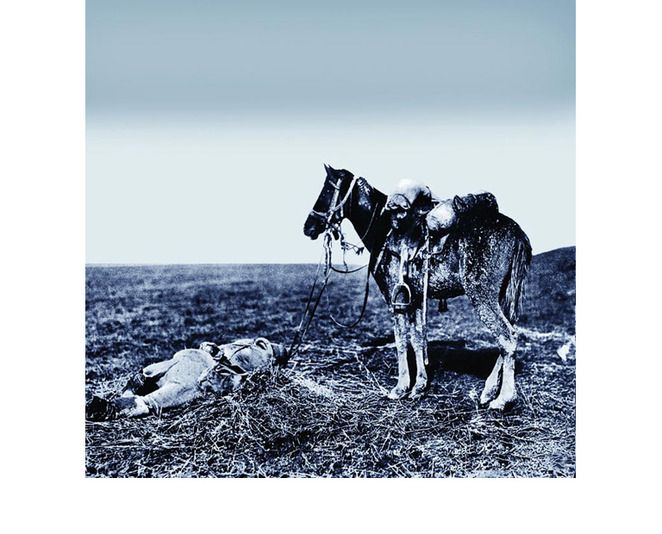 A young horse stands over the body of the rider who, even in death, clutches the reins of his mount.
Source
via
A young horse stands over the body of the rider who, even in death, clutches the reins of his mount.
Source
via
Showing posts with label war. Show all posts
Showing posts with label war. Show all posts
Wednesday, February 8, 2012
Horses at war


Thursday, February 2, 2012
Warhorse Royale
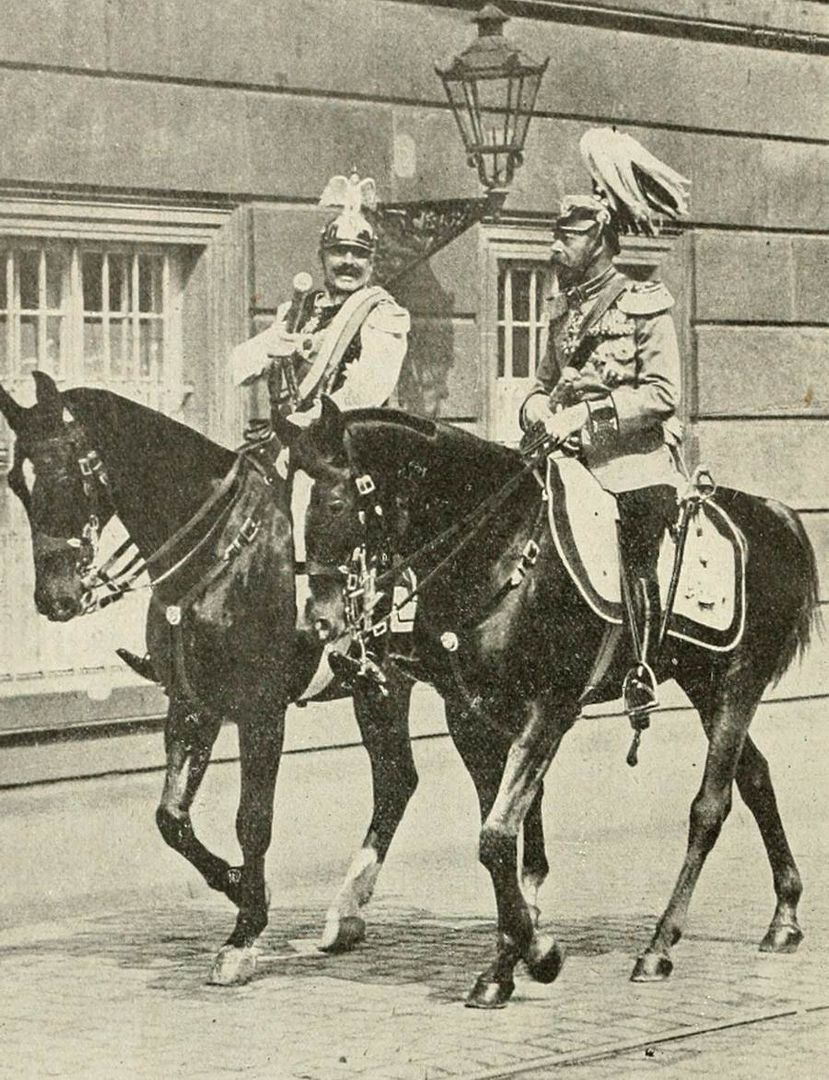 Kaiser Wilhelm II of Germany and King George V of England riding together on a London street
via
Kaiser Wilhelm II of Germany and King George V of England riding together on a London street
via
Tuesday, January 31, 2012
Semper Fido
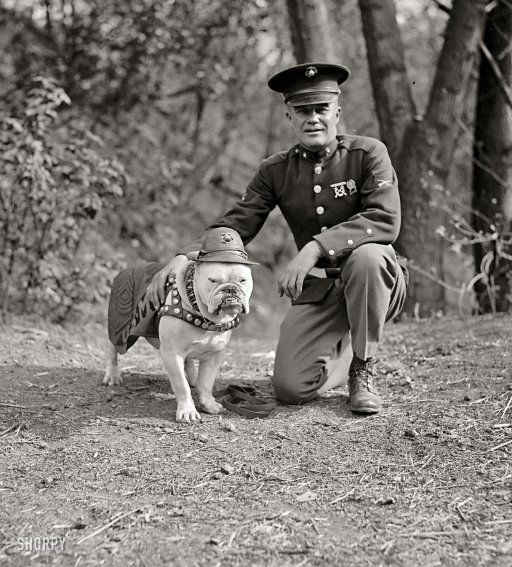 1925. "Sgt. Jiggs." The Marine Corps mascot in Washington, D.C., with an actual Marine. National Photo Company Collection glass negative.
The USMC got the nickname "Devil Dogs" from the Germans in World War I. The term "Devil Dog" in German is a legendary boogeyman from hell in German folklore. When they saw the fierceness with which the Marines fought in France, the Germans gave the USMC this name out of fear and respect. The Corps loved it and adopted the Bulldog as their mascot. The name persists today even though it is not widely known among the general public. There are some excellent history references on this subject at the Marine Museum at the USMC Recruit Depot at Parris Island, South Carolina.
Source
1925. "Sgt. Jiggs." The Marine Corps mascot in Washington, D.C., with an actual Marine. National Photo Company Collection glass negative.
The USMC got the nickname "Devil Dogs" from the Germans in World War I. The term "Devil Dog" in German is a legendary boogeyman from hell in German folklore. When they saw the fierceness with which the Marines fought in France, the Germans gave the USMC this name out of fear and respect. The Corps loved it and adopted the Bulldog as their mascot. The name persists today even though it is not widely known among the general public. There are some excellent history references on this subject at the Marine Museum at the USMC Recruit Depot at Parris Island, South Carolina.
Source
Sunday, January 29, 2012
Saturday, January 28, 2012
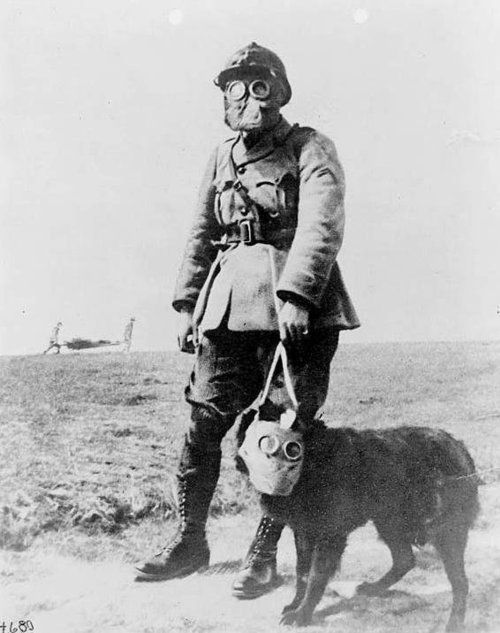
Red Cross Dog

Monday, May 9, 2011
Meet the Dogs of War
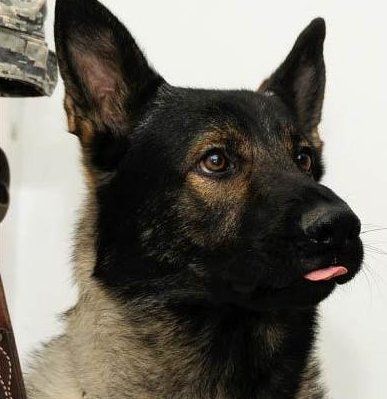 Their razor sharp teeth are made from titanium, their body armor can withstand clouds of hot shrapnel, and they've been trained to wear oxygen masks for high altitude dives into enemy territory.
Say hello to the US Military's dogs of war - including the bomb-sniffer that joined the hit squad of 79 Navy SEALS that took out Osama Bin Laden in a compound in Pakistan.
The dog would have dropped into the battle zone strapped to the chest of one of the SEAL team members as he rappelled from one of the three Black Hawk helicopters landing in Abottaban, Pakistan.
Wearing body armor equiped with an infrared camera, the dog could stream live images to team members in other parts of Obama's hide-out and back at the base. A radio mounted near the dog's ears would have let SEALS in other parts of the compound give orders to the dog.
Read more ...
Their razor sharp teeth are made from titanium, their body armor can withstand clouds of hot shrapnel, and they've been trained to wear oxygen masks for high altitude dives into enemy territory.
Say hello to the US Military's dogs of war - including the bomb-sniffer that joined the hit squad of 79 Navy SEALS that took out Osama Bin Laden in a compound in Pakistan.
The dog would have dropped into the battle zone strapped to the chest of one of the SEAL team members as he rappelled from one of the three Black Hawk helicopters landing in Abottaban, Pakistan.
Wearing body armor equiped with an infrared camera, the dog could stream live images to team members in other parts of Obama's hide-out and back at the base. A radio mounted near the dog's ears would have let SEALS in other parts of the compound give orders to the dog.
Read more ...
Thursday, February 17, 2011
Stubby, the heroic dog
 The single most decorated dog in U.S. history.
See my earlier post about Stubby, or
read more about Stubby at the Smithsonian Museum.
The single most decorated dog in U.S. history.
See my earlier post about Stubby, or
read more about Stubby at the Smithsonian Museum.
Tuesday, November 23, 2010
Soldiers and dogs deploy for Afghanistan
 FT. LEONARD WOOD, MO -- Families and friends said their farewells to about a dozen military men, women, and dogs Monday.
Ft. Leonard Wood held a deployment ceremony for the Engineer Canine Company, 5th Engineer Battalion.
The group included 5 working dogs and their handlers, plus 4 veterinarian technicians.
The soldiers are headed to Afghanistan to support Operation Enduring Freedom.
Source
FT. LEONARD WOOD, MO -- Families and friends said their farewells to about a dozen military men, women, and dogs Monday.
Ft. Leonard Wood held a deployment ceremony for the Engineer Canine Company, 5th Engineer Battalion.
The group included 5 working dogs and their handlers, plus 4 veterinarian technicians.
The soldiers are headed to Afghanistan to support Operation Enduring Freedom.
Source
Thursday, November 11, 2010
Animals in War
Veterans Day
We are blessed with selfless, caring, individuals who are willing to risk their lives to maintain our freedom and well being. Take a moment on this Veterans Day to remember the sacrifices of the humans and non-humans who give themselves up in service.
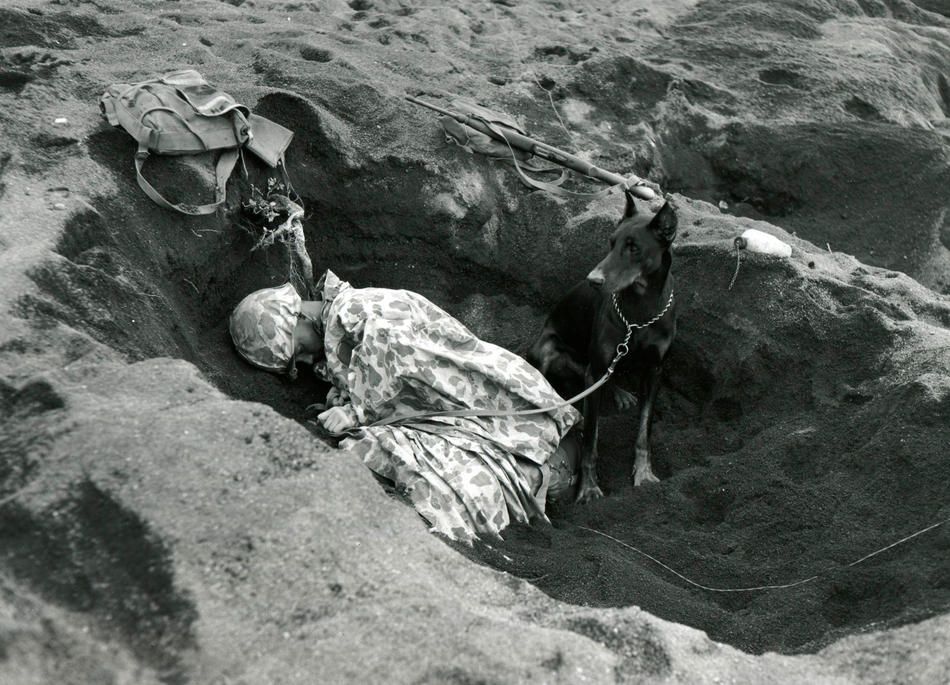 Throughout military history, animals have gone to war alongside humans. In On War: Animals in War see a gallery of photos from the Civil War to Iraq and Afghanistan.
Thursday, January 1, 2009
War dog joins Fox Lake American Legion
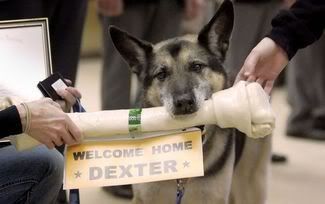 Fox Lake, Illinois, American Legion Post has a new member with four legs, a bite of about 1,200 pounds of pressure per square inch and a willingness to eat meat on a floor.
Dexter became the first military working dog to receive a membership card for American Legion Post 703 at a ceremony Wednesday. Post 703 Cmdr. Jerry Kandziorski said national Legion officials indicated it may well have been a first in the United States.
"He was a tried and true veteran," Kandziorski said. "He took his time in service and performed his duty. We think he deserves the recognition that should come to anybody."
Dexter is a Navy veteran who served in Iraq with his handler, Petty Officer 1st Class Kathleen Ellison. One of the 10-year-old German shepherd's heroic actions occurred in July 2004, when he detected explosives on the gas tank of a garbage truck that would have targeted a mess hall for U.S. troops at Abu Ghraib prison in Baghdad.
About 75 guests watched Dexter's membership ceremony at the Fox Lake American Legion hall, which was complete with an honor guard and invocation by Post 703 chaplain Bill Gordon.
Source: Daily Herald
Fox Lake, Illinois, American Legion Post has a new member with four legs, a bite of about 1,200 pounds of pressure per square inch and a willingness to eat meat on a floor.
Dexter became the first military working dog to receive a membership card for American Legion Post 703 at a ceremony Wednesday. Post 703 Cmdr. Jerry Kandziorski said national Legion officials indicated it may well have been a first in the United States.
"He was a tried and true veteran," Kandziorski said. "He took his time in service and performed his duty. We think he deserves the recognition that should come to anybody."
Dexter is a Navy veteran who served in Iraq with his handler, Petty Officer 1st Class Kathleen Ellison. One of the 10-year-old German shepherd's heroic actions occurred in July 2004, when he detected explosives on the gas tank of a garbage truck that would have targeted a mess hall for U.S. troops at Abu Ghraib prison in Baghdad.
About 75 guests watched Dexter's membership ceremony at the Fox Lake American Legion hall, which was complete with an honor guard and invocation by Post 703 chaplain Bill Gordon.
Source: Daily Herald
Monday, May 5, 2008
Front line canines
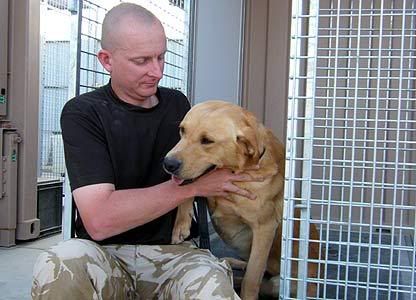 There are 20-25 dogs based throughout Helmand province in the south of Afghanistan where British troops are based.
Most are German Shepherds, Labradors or Spaniels. They may look cute and friendly, but these animals have a deadly job - sniffing out roadside bombs, and chasing and catching Taleban fighters, alive.
One sniffer or protection dog along with their handler can do the job of "four-six men" on the ground, meaning that those men can be deployed on other tasks.
Source: BBC
There are 20-25 dogs based throughout Helmand province in the south of Afghanistan where British troops are based.
Most are German Shepherds, Labradors or Spaniels. They may look cute and friendly, but these animals have a deadly job - sniffing out roadside bombs, and chasing and catching Taleban fighters, alive.
One sniffer or protection dog along with their handler can do the job of "four-six men" on the ground, meaning that those men can be deployed on other tasks.
Source: BBC
Monday, March 17, 2008
Baghdad Zoo Rebounding With Help from U.S. Vets
In better times, the Baghdad Zoo had more than 500 animals, including giraffes, elephants and exotic birds. But its location, inside Zawra Park in the city's center, put it in the middle of heavy fighting between invading U.S. troops and Saddam Hussein's forces in 2003. U.S. shells damaged the compound and inadvertently freed some animals; looting that followed the fall of Baghdad stripped away everything else.
 Thousands of North Carolina-based soldiers and Marines are trying to make things as normal as possible for Iraq's people. North Carolina-based veterinarians are trying to ensure that for some animals in that embattled country, life is a zoo.
 Veterinarians, students and animal researchers across the state are leading the effort to help the Baghdad Zoo -- once the Middle East's largest -- return to its pre-war glory days.
The U.S. established a Green Zone in Baghdad that included Zawra Park. Soldiers from the U.S. Army civil affairs were given oversight of the zoo. Cages and pens were rebuilt, and some animals were brought in. Last year, the N.C. Zoological Society raised money to buy computers to send to the zoo and got help from the military in getting an Internet connection. Eventually, zoo staff could use the connection to ask advice on how to treat the animals in their care.
While still not up to the standards of most zoos in the United States, the Baghdad Zoo is now an oasis for Iraqis, who stroll with babies amid grass and shade trees. The zoo has lions, camels, monkeys, bears, 23 aquariums' worth of fish, swans, eagles, donkeys, a hyena, a leopard, a fox, a few wolves and dogs.
Source: Red Orbit
Veterinarians, students and animal researchers across the state are leading the effort to help the Baghdad Zoo -- once the Middle East's largest -- return to its pre-war glory days.
The U.S. established a Green Zone in Baghdad that included Zawra Park. Soldiers from the U.S. Army civil affairs were given oversight of the zoo. Cages and pens were rebuilt, and some animals were brought in. Last year, the N.C. Zoological Society raised money to buy computers to send to the zoo and got help from the military in getting an Internet connection. Eventually, zoo staff could use the connection to ask advice on how to treat the animals in their care.
While still not up to the standards of most zoos in the United States, the Baghdad Zoo is now an oasis for Iraqis, who stroll with babies amid grass and shade trees. The zoo has lions, camels, monkeys, bears, 23 aquariums' worth of fish, swans, eagles, donkeys, a hyena, a leopard, a fox, a few wolves and dogs.
Source: Red Orbit
Monday, March 3, 2008
A special bond between soldiers in Iraq
 Iron, a German shepherd trained to sniff out explosives, weapons, wires and other threats, and handler Sgt. Joshua T. Rose, right, wait as military explosives experts investigate a bomb that Iron found south of Baghdad.
Sgt. Joshua Rose and Iron are one of about 200 canine teams deployed in Iraq, where the bond between soldiers and their dogs is so deep that some handlers have asked to be buried with their canine partners if they are killed together.
On frigid winter nights in the Iraqi desert, Rose shares his cot and sometimes his sleeping bag with Iron to keep him warm. In the scorching summer heat, he makes sure Iron has enough water before taking his own share. If the heat is too much for Iron, who has a thick coat of glossy black fur, Rose lets him rest, no matter what the platoon leader might want.
"These dogs are like our children. I'm closer to my dog than I am to anyone other than my wife," said Staff Sgt. Charles W. Graves, the kennel master at Forward Operating Base Kalsu, about 20 miles southeast of Baghdad.
Since the start of the Iraq war, about 1,000 dogs have passed through the combat zone, and three have been killed in action.
Their duties include sniffing out the roadside bombs, detecting booby-trap wires, searching for drugs and illegal weapons at border crossings, finding human remains and tracking and chasing down insurgents.
The war in Iraq is the first in which the military has sent dogs to serve as therapy animals for stressed-out troops.
Source: LA Times
The above referenced story was written by Tina Susman, Los Angeles Times Staff Writer, she has also created a war dog blog entry with more photos : IRAQ: Dog duty
Iron, a German shepherd trained to sniff out explosives, weapons, wires and other threats, and handler Sgt. Joshua T. Rose, right, wait as military explosives experts investigate a bomb that Iron found south of Baghdad.
Sgt. Joshua Rose and Iron are one of about 200 canine teams deployed in Iraq, where the bond between soldiers and their dogs is so deep that some handlers have asked to be buried with their canine partners if they are killed together.
On frigid winter nights in the Iraqi desert, Rose shares his cot and sometimes his sleeping bag with Iron to keep him warm. In the scorching summer heat, he makes sure Iron has enough water before taking his own share. If the heat is too much for Iron, who has a thick coat of glossy black fur, Rose lets him rest, no matter what the platoon leader might want.
"These dogs are like our children. I'm closer to my dog than I am to anyone other than my wife," said Staff Sgt. Charles W. Graves, the kennel master at Forward Operating Base Kalsu, about 20 miles southeast of Baghdad.
Since the start of the Iraq war, about 1,000 dogs have passed through the combat zone, and three have been killed in action.
Their duties include sniffing out the roadside bombs, detecting booby-trap wires, searching for drugs and illegal weapons at border crossings, finding human remains and tracking and chasing down insurgents.
The war in Iraq is the first in which the military has sent dogs to serve as therapy animals for stressed-out troops.
Source: LA Times
The above referenced story was written by Tina Susman, Los Angeles Times Staff Writer, she has also created a war dog blog entry with more photos : IRAQ: Dog duty
Sunday, January 20, 2008
The art of war
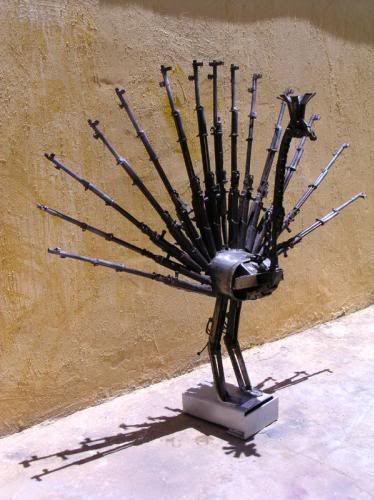 In 1998, the Cambodian government destroyed 125,000 weapons across the country.
The Peace Art Project Cambodia (PAPC) was created in November 2003 to get rid of the weapons in an artistic way.
See pictures of weapons sculpture and furniture at funnytogo.com.
(via)
In 1998, the Cambodian government destroyed 125,000 weapons across the country.
The Peace Art Project Cambodia (PAPC) was created in November 2003 to get rid of the weapons in an artistic way.
See pictures of weapons sculpture and furniture at funnytogo.com.
(via)
Wednesday, October 31, 2007
Cat honored by British Navy
 Royal Navy officers are paying tribute to Simon the cat, a rat-catcher on the HMS Amethyst who continued his duties despite being hit by shrapnel and singed during shelling raids by Chinese communists on the Yangtze River in 1949.
Simon stuck to his task despite injury during the 101-day summer siege that followed.
The communists withheld supplies for over three months while they used the ship as a political bargaining chip. But the black and white cat kept up morale and crew credited him with saving their lives by protecting dwindling food stores from a rat infestation.
Royal Navy officers are paying tribute to Simon the cat, a rat-catcher on the HMS Amethyst who continued his duties despite being hit by shrapnel and singed during shelling raids by Chinese communists on the Yangtze River in 1949.
Simon stuck to his task despite injury during the 101-day summer siege that followed.
The communists withheld supplies for over three months while they used the ship as a political bargaining chip. But the black and white cat kept up morale and crew credited him with saving their lives by protecting dwindling food stores from a rat infestation.
Thursday, October 4, 2007
7 Unusual Military Animals
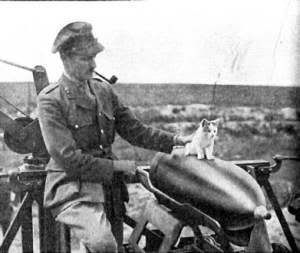 Humans, employing animals in their warfare ...
The earliest examples of cats being used in warfare dates back to the Ancient Egypt during a war against Persia. The Persians, fully aware of the reverence that Egyptians paid to their felines, rounded up as many cats as they could find and set them loose on the battlefield. When the Egyptians were faced with either harming the cats or surrendering, they chose the latter.
(via)
Humans, employing animals in their warfare ...
The earliest examples of cats being used in warfare dates back to the Ancient Egypt during a war against Persia. The Persians, fully aware of the reverence that Egyptians paid to their felines, rounded up as many cats as they could find and set them loose on the battlefield. When the Egyptians were faced with either harming the cats or surrendering, they chose the latter.
(via)
Tuesday, August 14, 2007
Killed in Iraq, dog team buried together
 The first military working dog team killed in action together since the beginning of the wars in Iraq and Afghanistan were laid to rest together July 18.
Cpl. Kory D. Wiens, 20, of the 94th Mine Dog Detachment, 5th Engineer Battalion, 1st Engineer Brigade of Fort Leonard Wood, Mo., and his partner, Cooper, were killed July 6 by an improvised explosive device while on patrol in Muhammad Sath, Iraq. They had been in Iraq since January.
The cremated remains of Wiens and Cooper, a Labrador retriever, were buried together at Salt Creek Cemetery in Wiens’ hometown of Dallas, Ore., at the request of his family.
The Army has 578 dog teams, and they have served several hundred rotations in Iraq and Afghanistan. Research indicates that the last military canine team to be killed together was during the Vietnam War.
The first military working dog team killed in action together since the beginning of the wars in Iraq and Afghanistan were laid to rest together July 18.
Cpl. Kory D. Wiens, 20, of the 94th Mine Dog Detachment, 5th Engineer Battalion, 1st Engineer Brigade of Fort Leonard Wood, Mo., and his partner, Cooper, were killed July 6 by an improvised explosive device while on patrol in Muhammad Sath, Iraq. They had been in Iraq since January.
The cremated remains of Wiens and Cooper, a Labrador retriever, were buried together at Salt Creek Cemetery in Wiens’ hometown of Dallas, Ore., at the request of his family.
The Army has 578 dog teams, and they have served several hundred rotations in Iraq and Afghanistan. Research indicates that the last military canine team to be killed together was during the Vietnam War.
Subscribe to:
Posts (Atom)